Trying to figure out whether cannabis is legal in the USA can feel like reading a map that redraws itself every few months. That’s not your fault. The rules change by state, by product, and lately, by the week.
Cannabis is legal for adult recreational use in 24 states and Washington, D.C., and about 40 states allow medical use. At the federal level, recreational cannabis is still a Schedule I controlled substance. Since April 2026, state-licensed medical marijuana sits in Schedule III. That split means the legality of cannabis depends on where you are, what you use it for, and who sells it.
In this blog, we will guide you on what federal law says, the full list of recreational cannabis states, the states where cannabis is illegal, what changed in 2026, and what the November 3 elections mean. We also cover what this patchwork means if you sell cannabis or hemp online.
Disclaimer: This article is for general information only and isn’t legal advice. Laws change quickly, so confirm details with your state’s cannabis regulator or a qualified attorney before you act.
Cannabis Legality in the USA at a Glance
Here’s the simplest way to picture cannabis legality by state in 2026. Every state falls into one of three buckets, and federal law sits on top of all of them. Think of it as a text version of a cannabis legalization map.
| Status | Number of States | What It Means |
|---|---|---|
| Recreational (adult use) and medical | 24 states + Washington, D.C. | Adults can legally possess cannabis under state law. Most of these states also run licensed stores. |
| Medical only | About 16 states | Registered patients with a qualifying condition can buy from licensed dispensaries. |
| Low-THC/CBD only or no program | About 10 states | No legal access to THC-rich cannabis, aside from narrow medical exceptions. |
These counts come from USAFacts and Statista. Trackers differ slightly because some count Texas’s expanded compassionate use program and Nebraska’s voter-approved medical law as full medical programs, and others don’t.
Public support still leans toward legalization. A November 2025 Gallup poll found that 64% of Americans back legal marijuana. That’s down from a 70% peak in 2023, mostly because Republican support dropped to 40%.
The legal market keeps growing anyway. US cannabis sales hit roughly $27 billion in 2025, according to The Marijuana Herald’s analysis of state sales data.
What Federal Law Says About Cannabis in 2026
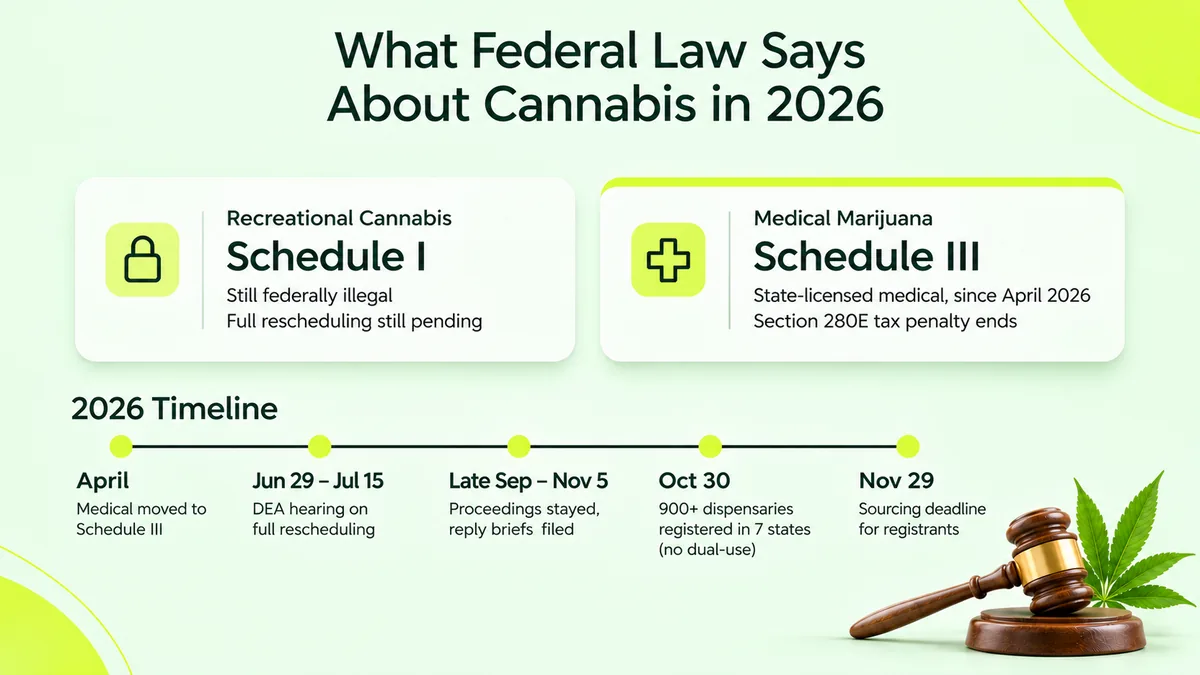
Federal law is where most of the confusion starts. For decades, the answer was simple: all marijuana was a Schedule I drug under the Controlled Substances Act. That changed partially this year, and the word “partially” matters a lot.
Recreational Cannabis Is Still Schedule I
Adult use cannabis, the kind sold in recreational dispensaries, remains a Schedule I controlled substance. The Congressional Research Service confirms that making, possessing, and distributing recreational marijuana stays federally illegal, except for approved research.
States don’t need federal permission to stop arresting people, though. That’s why rec cannabis can be legal under Colorado law while still breaking federal law on the very same street corner.
Medical Marijuana Moved to Schedule III in April 2026
In April 2026, the Justice Department issued a final order moving two categories into Schedule III:
- FDA-approved drug products that contain marijuana
- Marijuana covered by a qualifying state medical marijuana license
According to CRS, this opens a path for state-licensed medical businesses to comply with federal law. It also ends the harsh Section 280E tax penalty for those businesses going forward, as Duane Morris and other law firms have explained.
Full Rescheduling Is Still Pending
The DEA held a hearing from June 29 to July 15, 2026, on moving all marijuana to Schedule III. Progress since then has been slow. An administrative law judge temporarily stayed the proceedings in late September, and parties had until November 5 to file reply briefs.
The bottom line: as of early November 2026, no final rule moves recreational marijuana out of Schedule I.
The Detail Most Legality Guides Miss
Here’s something you won’t find in most “is cannabis legal” roundups. On October 30, 2026, the DEA issued its first federal registrations to more than 900 medical dispensaries, all in seven states: Alabama, Florida, Mississippi, South Dakota, Texas, Virginia, and West Virginia, per Marijuana Moment.
The catch? The DEA says it can’t register “dual-use” businesses that serve both patients and recreational customers. Registered businesses must also source only from other registered or timely applicants by November 29, 2026.
So Schedule III exists on paper for medical cannabis nationwide. In practice, federal protection depends heavily on how your state structures its licenses, which leaves many medical operators in recreational states waiting.
Recreational Cannabis States: The Full 2026 List
If you’re asking “what states have recreational cannabis,” here’s the complete list of states with legal recreational cannabis. Each one lets adults possess cannabis under state law, though possession limits and store availability differ.
| State | Year Approved | Worth Knowing |
|---|---|---|
| Alaska | 2014 | One of the earliest states to legalize |
| Arizona | 2020 | Voters approved Proposition 207 |
| California | 2016 | Largest legal market by sales |
| Colorado | 2012 | First to legalize, on the same day as Washington |
| Connecticut | 2021 | Legislature approved legalization |
| Delaware | 2023 | Retail sales began in August 2025 |
| Illinois | 2019 | Legislature approved; sales began January 2020 |
| Maine | 2016 | A 2026 repeal campaign missed the ballot deadline |
| Maryland | 2022 | Voters approved it with about 67% support |
| Massachusetts | 2016 | Voters rejected a repeal on November 3, 2026 |
| Michigan | 2018 | Among the top markets by monthly sales |
| Minnesota | 2023 | Legislature approved; licensed market still maturing |
| Missouri | 2022 | Constitutional amendment passed with about 53% |
| Montana | 2020 | Voter-approved initiative |
| Nevada | 2016 | Possession limit rose to 2.5 ounces in 2024 |
| New Jersey | 2020 | Voters approved a constitutional amendment |
| New Mexico | 2021 | Legislature approved legalization |
| New York | 2021 | Legislature passed the MRTA |
| Ohio | 2023 | SB 56 tightened rules in March 2026 |
| Oregon | 2014 | Voter-approved initiative |
| Rhode Island | 2022 | Legislature approved legalization |
| Vermont | 2018 | First state to legalize through its legislature |
| Virginia | 2021 | Possession legal; retail sales start July 1, 2027 |
| Washington | 2012 | Legalized alongside Colorado |
| Washington, D.C. | 2014 | Possession legal; Congress blocks a licensed recreational market |
Notice Virginia? Adults can legally possess cannabis there, but no licensed recreational store exists yet. Under a budget law enacted in June 2026, retail sales begin July 1, 2027, with up to 350 shops allowed statewide.
Ohio is the other one to watch. Its SB 56 changes, effective March 20, 2026, capped THC potency, moved intoxicating hemp into dispensaries, and barred residents from possessing cannabis bought outside Ohio.
Medical Cannabis States (Medical Only)
These medical cannabis states let registered patients buy cannabis for qualifying conditions, but they don’t allow recreational use:
| Medical-Only States in 2026 | |||
|---|---|---|---|
| Alabama | Arkansas | Florida | Hawaii |
| Kentucky | Louisiana | Mississippi | Nebraska* |
| New Hampshire | North Dakota | Oklahoma | Pennsylvania |
| South Dakota | Texas* | Utah | West Virginia |
The two asterisks matter. Nebraska voters approved medical cannabis in 2024, but the rollout has stayed narrow. Texas runs a limited compassionate use program that it expanded in 2025. That’s why you’ll see some sources count 38 medical states and others count 40.
Florida and Pennsylvania are the giants on this list. In Florida, a 2024 legalization amendment won about 56% of the vote but missed the 60% the state requires, and the 2026 petition fell about 100,000 signatures short of qualifying.
Pennsylvania’s outlook changed on Election Day, which we cover in the elections section below.
States Where Cannabis Is Illegal (or Nearly So)
About 10 states still have no comprehensive medical program and no recreational market. Most allow only low-THC or CBD oil for specific conditions, and a couple allow almost nothing at all:
- Georgia: low-THC oil program for registered patients
- Idaho: no medical or recreational access
- Indiana: hemp-derived CBD only
- Iowa: a tightly limited medical cannabidiol program
- Kansas: no meaningful program
- North Carolina: no state medical or recreational program
- South Carolina: CBD oil for a short list of conditions
- Tennessee: a narrow CBD exception only
- Wisconsin: CBD oil only
- Wyoming: CBD oil for certain epilepsy patients
Possession in these states can still mean criminal charges, so “where is cannabis legal” isn’t an academic question if you travel. Even a small amount bought legally in a neighboring state counts as illegal the moment you cross the border.
How Cannabis Laws by State Differ, Even Where It’s Legal
Living in one of the legal cannabis states is only step one. After a state legalizes, it still writes its own limits, taxes, and product rules, and cities often get a say too. That’s why the same purchase can be routine in one state and a problem in the next.
Possession Limits Range From 1 Ounce to 6 Ounces
Possession limits vary far more than most people expect. Several states also allow much more at home than in public. Here’s a sample drawn from The Marijuana Herald’s review of state possession limits, Illinois’s official cannabis FAQ, and NORML’s Arizona summary:
| State | Adult Possession Limit |
|---|---|
| Arizona | 1 ounce, with no more than 5 grams as concentrate |
| Massachusetts | 1 ounce in public; 10 ounces at home |
| Colorado | 2 ounces |
| Minnesota | 2 ounces in public; 2 pounds at home |
| Illinois (residents) | 60 grams of flower, or about 2 ounces |
| Michigan | 2.5 ounces in public; 10 ounces at home |
| Missouri | 3 ounces |
| New York | 3 ounces, plus 24 grams of concentrate |
| New Jersey | 6 ounces |
Concentrates and edibles usually carry separate, much smaller caps. So when someone says a state allows “an ounce,” that rarely tells the whole story.
Taxes Swing From Single Digits to Stacked Rates
Every recreational state taxes cannabis its own way. Some add one modest excise tax, while others stack wholesale, retail, and local taxes on top of each other. Here’s how a few states compare, based on The Marijuana Herald’s state tax roundup and more recent state updates:
| State | How Adult Use Cannabis Is Taxed |
|---|---|
| Missouri | 6% excise, plus up to 3% in local taxes |
| Maryland | 12% sales tax, up from 9% on July 1, 2025 |
| California | 15% excise plus regular sales tax; a brief jump to 19% reversed on October 1, 2025 |
| Illinois | 10% to 25% excise based on product type and potency, plus 6.25% sales tax |
| Michigan | 10% excise and 6% sales tax, plus a 24% wholesale tax since January 1, 2026 |
Maryland’s increase comes straight from the state Comptroller. Michigan’s wholesale tax is still in court, though. In April 2026, the Michigan Supreme Court ordered an expedited appeals review, so that rate could still change.
Your City Can Say No to Dispensaries
Statewide legalization doesn’t guarantee a store anywhere near you. Michigan, New Jersey, and New York all let local governments opt out of hosting cannabis businesses, and plenty of towns did.
California shows how far this goes. According to the state’s Department of Cannabis Control, 302 of its 540 cities and counties, or 56%, don’t allow any retail cannabis business as of February 2026.
These local bans target storefronts, not people. Adults in those towns can still possess cannabis legally, and some states, including California, allow licensed delivery into many of those areas.
Product and Packaging Rules Change at the Border
Product rules shift from state to state as well. Many states cap edibles at 10 mg of THC per serving and 100 mg per package. Nevada, for example, uses exactly that standard.
Some programs restrict whole product categories. Alabama’s medical law bans smokable and vaped products, so patients there buy tablets, capsules, gummies, oils, and topicals instead, as the Marijuana Policy Project explains.
Labels get tricky too. Legal states generally require child-resistant packaging and their own THC warning symbol, so a package that passes in Colorado can fail in California. For multi-state brands, that means separate packaging, labels, and product pages for each market.
What Changed in 2026: Key Dates at a Glance
A lot happened this year. If you only skim one part of this guide, make it this timeline of us cannabis laws in 2026:
| Date | What Happened |
|---|---|
| February 2026 | Florida’s recreational cannabis petition fails to qualify for the ballot |
| March 20, 2026 | Ohio’s SB 56 takes effect, tightening adult use rules |
| April 2026 | DOJ moves FDA-approved and state-licensed medical marijuana to Schedule III |
| June 3, 2026 | Alabama’s first medical cannabis dispensary opens |
| June 18, 2026 | The Supreme Court rules 9-0 in United States v. Hemani |
| June 29, 2026 | Virginia’s budget law sets retail sales for July 1, 2027; the DEA rescheduling hearing begins |
| July 1, 2026 | Tennessee’s ban on THCA sales takes effect |
| September 2, 2026 | H.R. 6500 becomes law, delaying most federal hemp rules to December 11 |
| October 30, 2026 | DEA registers 900+ medical dispensaries in seven states |
| November 3, 2026 | Massachusetts voters reject repeal; Idaho voters reject HJR 4 |
| November 12, 2026 | Non-natural cannabinoids lose federal hemp status; Illinois Hemp Act takes effect |
| December 11, 2026 | The federal total THC standard and 0.4 mg per container cap take effect |
What the November 2026 Elections Mean for Cannabis
For the first time in more than a decade, no state asked voters to legalize cannabis this year, Cannabis Now reports. The two statewide measures that did appear tried to roll things back, and both failed:
- Massachusetts: About 76% of voters rejected Question 8, which would have ended licensed recreational sales.
- Idaho: Roughly two-thirds of voters rejected House Joint Resolution 4, which would have blocked citizen initiatives on marijuana.
Races for state offices may matter even more for cannabis legalization by state in 2027:
- Pennsylvania: Democrats claimed a state Senate majority, giving them unified control. Advocates now call 2027 their best shot at legalization.
- Wisconsin: Voters elected David Crowley, who backs legalization, as governor, and Democrats flipped both legislative chambers, per GreenState.
- Texas: Lt. Gov. Dan Patrick, the leading backer of the 2025 hemp THC ban bill, lost his reelection race to Vikki Goodwin.
These results are still unofficial, and new legislatures don’t pass bills overnight. Neither Pennsylvania nor Wisconsin lets citizens put legalization on the ballot, so any change there will come from lawmakers.
Hemp vs. Cannabis: The Federal Deadline You Can’t Ignore
Here’s where a lot of online sellers get tripped up. Hemp-derived THC products, like delta-8, THCA flower, and hemp delta-9 gummies, were never “legal cannabis.” They rode a loophole in the 2018 Farm Bill. Our CBD vs. THC guide covers the chemistry basics.
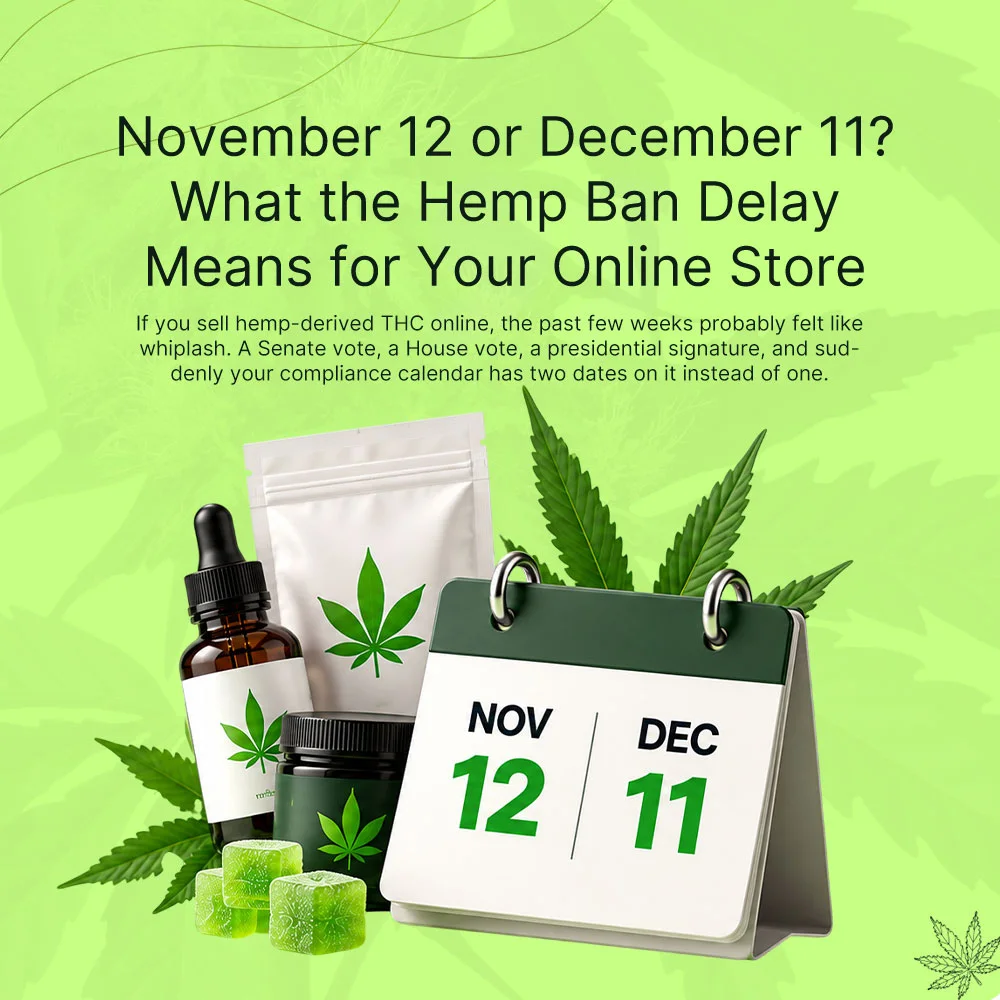
A November 2025 law rewrote the federal definition of hemp. After a short delay signed in September 2026, it now lands in two steps, as the Congressional Research Service and our hemp ban delay breakdown explain:
- November 12, 2026: Products with cannabinoids the cannabis plant can’t naturally produce, like THC-O acetate, lose hemp status.
- December 11, 2026: The total THC standard (which counts THCA) and a 0.4 mg total THC per container cap take effect.
Once a product fails that definition, federal law treats it as marijuana. That means no mailing it, since USPS only accepts hemp that meets the legal definition, and probably no coverage from your payment processor either.
For the full background, read our guide to the November 2026 federal hemp ban. If your catalog leans on delta-8 or THCA, our Delta-8 & THCA Migration service helps you reformulate, geo-restrict, or move into licensed channels.
Legal in Your State Doesn’t Mean Legal Everywhere
Even in legal cannabis states, federal law still controls plenty of everyday situations. Here’s how the two layers compare:
| Situation | State Law (in a Legal State) | Federal Law |
|---|---|---|
| Buying at a licensed recreational dispensary | Legal for adults | Illegal (Schedule I) |
| Buying at a DEA-registered medical dispensary | Legal for registered patients | Schedule III; a valid state certification counts |
| Driving into another state with cannabis | Often illegal; Ohio bans out-of-state products | Illegal |
| Possessing cannabis in a national park or on a military base | State law doesn’t apply | Illegal |
| Mailing cannabis | Illegal | Illegal |
| Shipping hemp CBD with 0.4 mg or less total THC per container | Usually legal | Legal |
Gun ownership is another gray zone. In June 2026, the Supreme Court ruled 9-0 in United States v. Hemani that the government couldn’t prosecute a regular marijuana user for gun possession on those facts alone.
That ruling is narrow, though, and the federal gun purchase form still asks about unlawful drug use. And driving while impaired by cannabis remains a crime in every state, no matter what the local cannabis law says.
What the Legality of Cannabis Means for Online Cannabis and Hemp Brands
We build and maintain stores for regulated brands every day, so here’s the practical side. The legality of cannabis by U.S. jurisdiction shapes your website just as much as your product line.
- Licensed cannabis can’t ship across state lines. Even between two legal states, marijuana has to stay in-state. Dispensary sites focus on menus, preorders, and delivery where allowed. Our guide to cannabis website design and development explains how those builds differ.
- Hemp stores need state, SKU, and date rules. A product might stay federally legal until December 11 but already be restricted in Tennessee or Ohio. Smart automation workflows can block restricted items by state and switch them off on schedule.
- Payments need a backup plan. Mainstream processors rarely touch THC products, so high-risk merchant accounts and backup gateways matter. Our guide to custom website development for high-risk niches covers the setup.
- Your platform choice matters. Shopify allows some hemp CBD sales in the US but prohibits THC products, which pushes many brands to WordPress. Our WooCommerce vs Shopify comparison walks through the tradeoffs.
- Age gates and compliant copy protect you. Strong age verification at entry and checkout, plus product pages free of medical claims, keep regulators, processors, and ad platforms happy. Our CBD website development team builds these in from day one.
Pivoting away from intoxicating hemp? Adjacent categories like functional mushrooms can keep a national DTC store running. See our mushroom website development services for what that looks like.
Not sure where your store stands? Book a free 30-minute strategy call with the team at High Stack Solutions, or browse our recent work with Kratom, CBD, and Delta brands.
Conclusion
The legality of cannabis in the USA comes down to three layers. First, your state: 24 states and D.C. allow recreational use, about 16 more allow medical use only, and roughly 10 still restrict nearly everything.
Second, federal law. Recreational cannabis stays in Schedule I, while state-licensed medical marijuana moved to Schedule III in April 2026. Full rescheduling remains unresolved, and the DEA’s new registration rules leave many dual-use operators waiting.
Third, the product itself. Hemp-derived THC follows its own federal clock, with deadlines on November 12 and December 11, 2026. Add this week’s election results, Virginia’s 2027 retail launch, and Ohio’s new rules, and the map will keep shifting. Check your state’s official cannabis program often, and keep your store’s compliance just as current.
Frequently Asked Questions
What is the legal age to buy recreational cannabis?
You must be 21 or older with a valid government ID in every recreational state. Medical programs may serve younger patients, usually through a registered caregiver with parental consent.
Can tourists buy cannabis in recreational states?
Yes. Out-of-state adults with a valid ID can buy from licensed stores in recreational states. Some states, like Illinois, cap non-residents at lower amounts, such as 30 grams of flower.
Can you fly with cannabis in the US?
No, not legally. Airports and flights fall under federal law. TSA doesn’t search for cannabis, but officers refer suspected cannabis to law enforcement, even in legal states.
Can you grow cannabis at home legally?
In most recreational states, yes, usually up to six plants per adult. Washington and New Jersey ban recreational home grows, and Illinois only lets registered medical patients grow.
Does a medical card from one state work in another?
Sometimes. Nevada, Arkansas, and Maine are among the states that honor out-of-state medical cards or offer visitor registrations. Many states don’t, so check your destination’s rules before traveling.
Can you get fired for using cannabis legally?
It depends. New York, New Jersey, and Connecticut protect many workers’ legal off-duty use, but federal contractors and DOT-regulated jobs, like commercial trucking, can still test and fire.
Can you smoke cannabis in public in a legal state?
Usually not. Almost every legal state bans public consumption and fines violators. Some places, like Nevada and Alaska, license consumption lounges or on-site use areas instead.