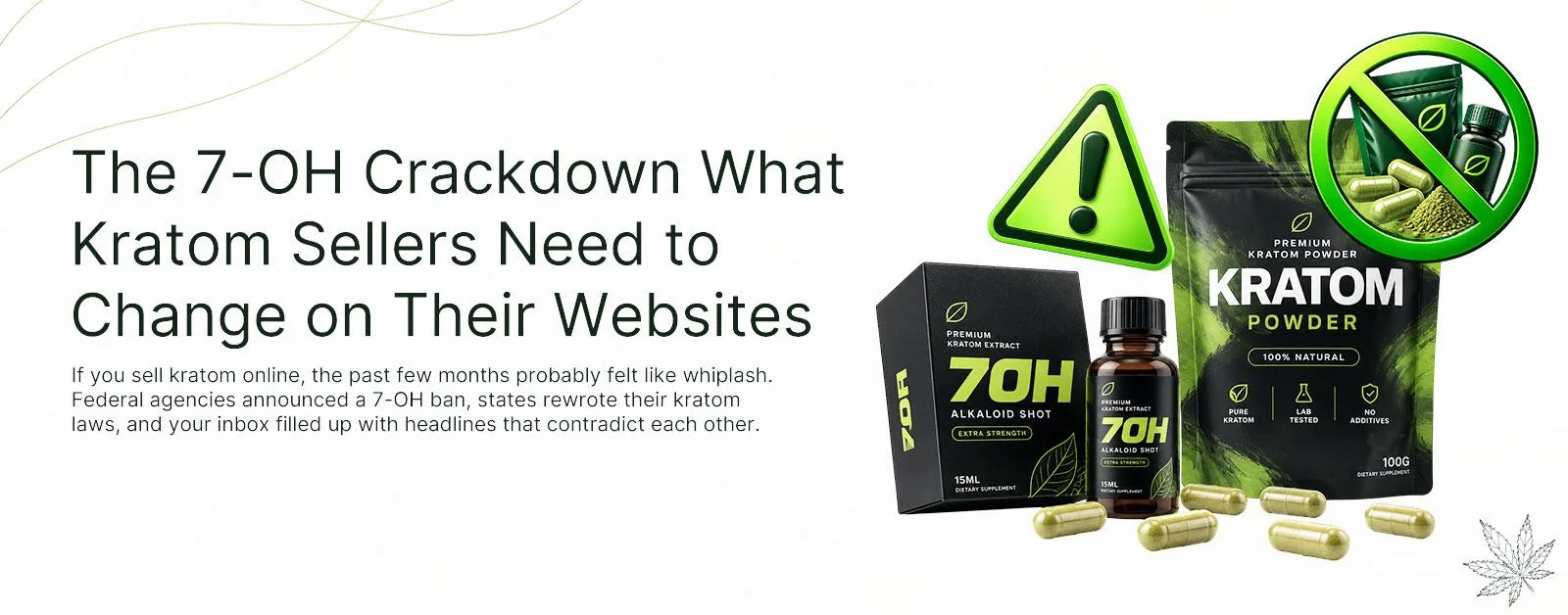
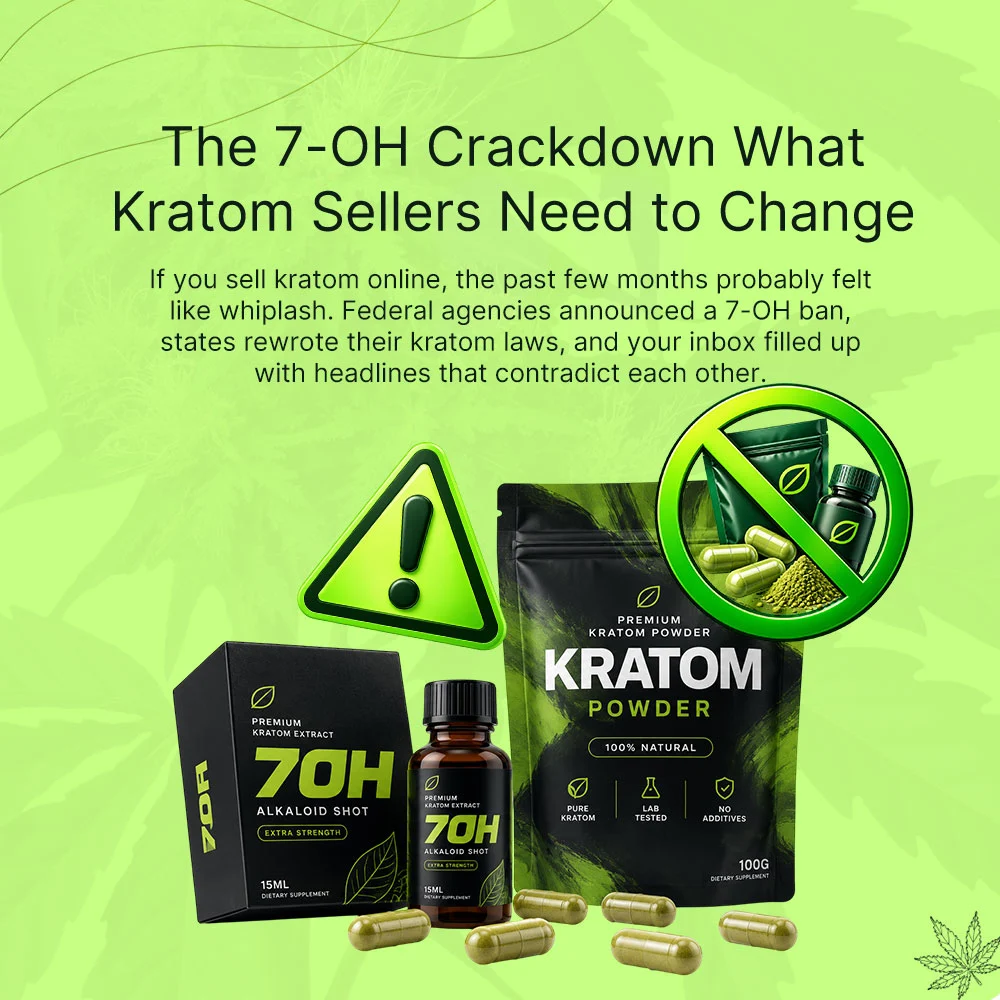
If you sell kratom online, the past few months probably felt like whiplash. Federal agencies announced a 7-OH ban, states rewrote their kratom laws, and your inbox filled up with headlines that contradict each other.
The 7-OH ban targets concentrated and synthetic 7-hydroxymitragynine, not natural kratom leaf. Three related compounds (MP, MGM-15, and MGM-16) became federal Schedule I substances on August 26, 2026. The DEA’s order for 7-OH above a 0.05% or 1 mg threshold is still pending. Sellers should pull covered products, fix website copy, verify lab results, and tighten state-level geo-blocking before the next order drops.
In this blog, we are going to breakdown what changed in the Kratom law, what is still pending, and exactly what to update on your online Kratom store so you can keep selling with confidence.
Disclaimer: This article is for general information only and is not legal advice. Kratom laws change quickly, so confirm current federal, state, and local rules with a qualified attorney before making business decisions.
What Is the 7-OH Ban?
7-OH is short for 7-hydroxymitragynine, a minor alkaloid that occurs naturally in kratom leaves in tiny amounts. Manufacturers learned to concentrate it, or convert mitragynine into it, and then sell it as tablets, gummies, and liquid shots.
The problem? Concentrated 7-OH binds strongly to the brain’s opioid receptors. The FDA recommended scheduling certain 7-OH products on July 29, 2025, and made a point of saying it was not targeting natural kratom leaf.
Then, on July 1, 2026, the DEA filed two notices of intent to temporarily place 7-OH above a set threshold, plus three related compounds, into Schedule I of the Controlled Substances Act. That is the action most people now call the 7-OH ban.
Does the 7-OH Ban on Kratom Affect Natural Leaf?
Federally, no. Plenty of headlines describe a 7-OH ban on Kratom as a whole, but the DEA drew a clear line between the plant and manufactured products.
According to the Congressional Research Service, the planned scheduling does not apply to the kratom plant or its derivatives as long as their 7-OH levels stay below the specified thresholds.
State law is a different story, which we cover below. Some states now ban all kratom, leaf included, so the federal carve-out does not protect you everywhere.
Two DEA Dockets, Two Very Different Timelines
This is where most sellers get tripped up. The kratom 7-OH DEA action started as one package in July, but it has since split into two separate dockets:
- DEA-1644 (MP, MGM-15, and MGM-16): Final. The temporary scheduling order took effect August 26, 2026, and runs until August 26, 2028. It covers any amount of these compounds, with no threshold at all.
- DEA-1570 (7-OH above a threshold): Still pending. HHS extended the public comment period to September 10, 2026. At the time of writing, the DEA had not published a final order.
In plain terms, if your catalog still lists “7-OH alternatives” built on MGM-15 or pseudoindoxyl, those products are already illegal under federal law. Take them down today.
Is 7-OH Legal Right Now?
Here is the honest answer to “is 7-OH legal” as of late September 2026: concentrated 7-OH is not yet federally scheduled, but it sits one Federal Register publication away from Schedule I.
That detail matters more than the date. A temporary scheduling order takes effect the day it publishes, with no grace period, phase-in, or extra warning. There is no countdown clock for your store.
Meanwhile, many states already ban 7-OH or kratom outright. So “federally legal for now” does not mean legal where your customer lives. The first public comment window alone drew more than 32,000 comments, which shows how contested this fight is.
Kratom 7-OH DEA timeline at a glance:
| Date | What Happened | What It Means for Sellers |
|---|---|---|
| July 29, 2025 | FDA recommends scheduling concentrated 7-OH | Regulators signal enforcement; warning letters follow |
| July 1, 2026 | DEA files two notices of intent | The temporary Schedule I process officially begins |
| July 6, 2026 | Notices publish; HHS opens threshold comments | 0.05% or 1 mg per article threshold proposed |
| July 31, 2026 | First comment window closes | Heavy public input delays the 7-OH order |
| August 26, 2026 | MP, MGM-15, and MGM-16 become Schedule I | “7-OH alternative” products must come down |
| September 10, 2026 | Extended comment period closes | The 7-OH order can publish on any business day |
How the DEA Threshold Works (and Why Your Lab Results Matter)
The proposed threshold is more specific than most blog posts suggest. Based on the DEA’s notice in the Federal Register, Schedule I would cover:
- Kratom plant material with more than 0.050% 7-OH on a dry weight basis
- Synthetic products with more than 0.050% 7-OH, or more than 1.00 mg of 7-OH per article
- Processed kratom products, such as extracts, concentrates, edibles, and pressed pills, that exceed those limits because of chemical, thermal, or other processing
That 1 mg per article limit is tiny. One survey of 250 products found single doses ranging from 1 mg to 700 mg, which puts nearly every 7-OH tablet, gummy, or shot far above the line.
The Detail Most Kratom Sellers Miss
Here is the nuance a generic compliance article won’t tell you. The threshold looks at what ends up in the finished product, not what you intended to put in it.
An extract that never had 7-OH added can still cross 0.05% if heat or chemical processing converts alkaloids during manufacturing. So a clean COA on your raw leaf proves nothing about your extract shots or pressed tablets.
MP adds a second wrinkle. It is scheduled at any amount, and the DEA describes it as a rearrangement product of 7-OH. The American Kratom Association even filed a lawsuit asking a court to confirm the MP order does not reach botanical leaf with trace amounts. Until that is settled, test finished goods for both 7-OH and MP, batch by batch.
State Laws Are Moving Faster Than the DEA
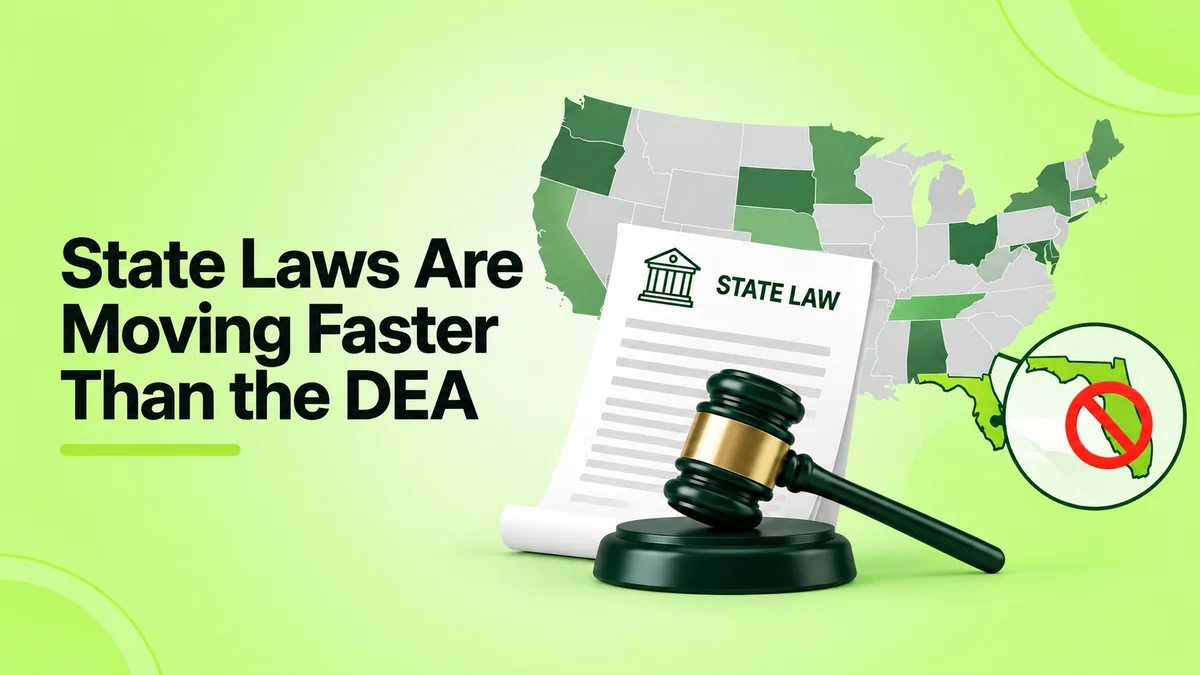
States keep raising it, and your checkout has to keep up with every change. Florida shows how fast things can escalate. Its attorney general expanded the state’s emergency rule in June 2026 after products appeared that dodged the first one, citing at least 587 overdose deaths linked to 7-OH and related compounds.
The new rule caps covered compounds at 1 mg per gram and requires at least 100 times more mitragynine by mass, according to the attorney general.
| State | What Changed | Effective | What Your Website Must Do |
|---|---|---|---|
| Florida | Seven 7-OH-related compounds in Schedule I, 1 mg per gram cap, 100:1 mitragynine ratio | June 22, 2026 | Block noncompliant SKUs for FL addresses; show ratios on COAs |
| Tennessee | Full kratom ban covering possession, sale, and distribution | July 1, 2026 | Block all kratom orders to TN |
| Massachusetts | DPH emergency order placing all kratom in Schedule I for up to one year | August 28, 2026 | Block all kratom orders to MA |
| Alabama, Arkansas, Indiana, Louisiana, Vermont, Wisconsin | Commonly listed full kratom bans, which include 7-OH | Varies | Keep permanent state blocks in place |
Local rules add one more layer. Places like Denver and Sarasota County restrict kratom even though their states allow it. That is why state-level blocking alone is not enough anymore.
10 Website Changes Kratom Sellers Need to Make Now
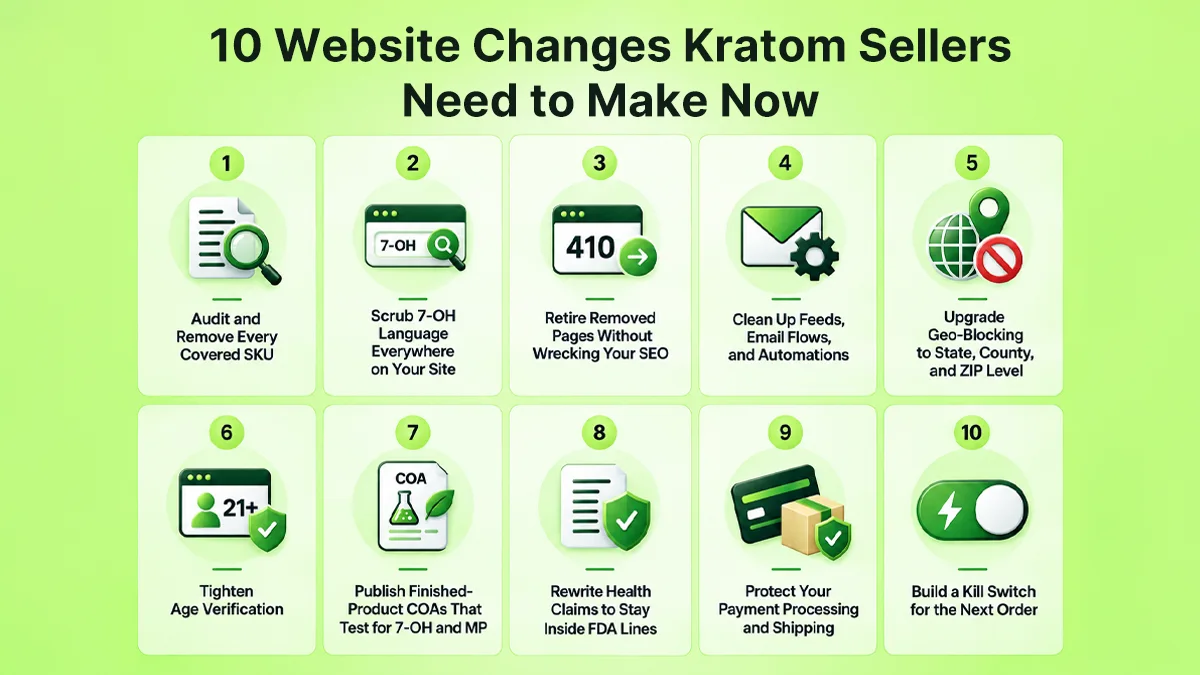
These are the changes we prioritize when we audit stores for kratom compliance after the 7-OH crackdown. Work through them in order, because the first few carry the most risk.
1. Audit and Remove Every Covered SKU
- Export your full catalog, including drafts, archived items, and bundles.
- Flag anything marketed as 7-OH, “enhanced,” “alkaloid-boosted,” or “pseudo,” plus any MGM-15 or MP product.
- Check each variant, since a compliant powder can hide a noncompliant “extra strength” option.
- Remove covered items from wholesale portals and B2B price lists too.
Gummies deserve a second look. Leaf-based kratom gummies can be compliant, but many “extract gummies” carry concentrated alkaloids. And don’t just mark products “out of stock,” because those pages stay live and still look like an offer to sell.
2. Scrub 7-OH Language Everywhere on Your Site
Regulators and payment processors read your site the way Google does: every single word. Search your database, not just visible pages, for terms like 7-OH, 7-hydroxy, 7OH, MGM-15, and pseudoindoxyl. Common hiding spots include:
- Meta titles, meta descriptions, and image alt text
- URL slugs, category names, and product tags
- Old blog posts that pitch 7-OH as a “stronger” kratom option
- Customer reviews and Q&A sections describing 7-OH effects
- On-site search synonyms and autocomplete suggestions
3. Retire Removed Pages Without Wrecking Your SEO
Deleting pages in a panic creates a pile of 404 errors and broken internal links. A cleaner approach looks like this:
- Return a 410 (Gone) status for pages tied only to banned products.
- Use 301 redirects to point pages with valuable backlinks to a relevant compliant category.
- Remove retired URLs from your XML sitemap and product structured data.
- Use the Google Search Console removals tool to hide outdated snippets faster.
This protects the authority your domain has earned while sending a clear signal that you no longer sell those products.
4. Clean Up Feeds, Email Flows, and Automations
Your website is more than its pages. Automated systems keep promoting products long after you pull them from the shelf.
- Purge covered SKUs from Google Merchant Center and marketplace feeds.
- Audit abandoned-cart, browse-abandonment, and win-back emails that mention 7-OH.
- Cancel subscriptions and auto-ship orders for covered products, then notify those customers.
- Deactivate affiliate links and coupon codes tied to banned items.
Our email marketing guide for high-risk niches walks through how to rebuild these flows so they stay compliant and still convert.
5. Upgrade Geo-Blocking to State, County, and ZIP Level
A simple state dropdown restriction no longer cuts it. Your checkout needs rule-based blocking that checks the shipping address, not just the billing state.
- Keep a restricted-location table your team can update in minutes.
- Apply rules per product, since some states ban 7-OH but still allow leaf.
- Block ZIP codes for cities and counties with local bans.
- Stop restricted orders at the cart, before payment, to avoid refunds and chargebacks.
Our automation for kratom service syncs these rules with your fulfillment and inventory systems, so a new state law doesn’t mean a week of manual work.
6. Tighten Age Verification
Many states that follow the Kratom Consumer Protection Act model set a minimum purchase age of 18 or 21, and plenty of sellers now default to 21+ nationwide. A click-to-enter popup is the bare minimum, not a compliance strategy.
Stronger setups pair an entry age gate with a date-of-birth field at checkout and third-party ID verification for first orders. Keep verification logs, because they become your proof if a regulator or processor ever asks.
7. Publish Finished-Product COAs That Test for 7-OH and MP
Lab transparency is now your strongest trust signal. Every product page should link to a current, batch-specific certificate of analysis from an accredited third-party lab. Make sure each COA:
- Reports 7-OH both as a percentage and in milligrams per serving
- Screens for MP, MGM-15, and other scheduled analogues
- Shows mitragynine levels, which matters under Florida’s 100-to-1 ratio rule
- Matches the batch number printed on the package
Add a batch lookup tool so customers can verify their exact product in seconds. It builds trust and cuts down on support emails.
8. Rewrite Health Claims to Stay Inside FDA Lines
The FDA’s position, as the CRS summary notes, is that kratom can’t be lawfully marketed as a drug, dietary supplement, or food additive. Claims about pain relief, anxiety, or opioid withdrawal invite warning letters.
Review product descriptions, FAQs, and influencer content. Swap treatment language for factual details like origin, strain, lab results, and serving information. Add clear safety warnings about dependence, drug interactions, and keeping products away from children.
9. Protect Your Payment Processing and Shipping
Payment processors review your catalog regularly, and a scheduled substance on a live page is a fast track to termination. A termination tied to illegal transactions can also land you on Mastercard’s MATCH list for up to five years.
- Send your processor an updated product list once covered SKUs are gone.
- Keep a backup gateway configured, tested, and ready to switch on.
- Document every compliance change with dates and screenshots.
Shipping is the other chokepoint. USPS prohibits mailing controlled substances except by DEA registrants, so shipping a covered product after scheduling creates a separate federal problem.
10. Build a Kill Switch for the Next Order
Remember, the 7-OH order takes effect the day it publishes. You need a response plan you can execute in under an hour.
- Tag every at-risk SKU now so you can unpublish them in one bulk action.
- Pre-write a customer notice and site banner explaining the change.
- Assign one person to check the Federal Register and state agency updates daily.
- Pause scheduled emails, ads, and social posts that mention affected products.
Ongoing web maintenance and support makes this realistic, because someone is already watching your store when the news breaks.
Your 7-OH Compliance Audit at a Glance
Use this table as a quick checklist during your next team meeting.
| Website Area | What to Check | Priority |
|---|---|---|
| Product catalog | 7-OH, MP, and MGM-15 SKUs, variants, and bundles | Immediate |
| Content and metadata | Copy, alt text, slugs, reviews, and old blog posts | Immediate |
| Checkout rules | State, county, and ZIP blocks applied per product | Immediate |
| Feeds and email | Merchant Center, automated flows, subscriptions | High |
| Lab results | Batch COAs testing finished goods for 7-OH and MP | High |
| Payments and shipping | Processor notice, backup gateway, carrier rules | High |
| SEO cleanup | 410s, redirects, sitemap, structured data | Medium |
| Monitoring | Federal Register and state agency alerts | Ongoing |
Why Proactive Kratom Compliance Pays Off
It’s easy to see all of this as pure cost but the 7-OH crackdown also clears out a crowded market, and compliant sellers stand to gain the most.
Kratom use remains widespread. A University of Michigan study found more than 5 million Americans have used kratom, with lifetime use rising from 1.6% in 2021 to 1.9% in 2024. Those shoppers still want brands they can trust.
If this feels familiar, it should. Delta-8 and THCA brands are going through a similar reset, which we covered in Delta-8 & THCA Banned in 2026. The lesson from both markets is the same: brands that rebuild early keep their customers when careless competitors disappear overnight.
How High Stack Solutions Helps Kratom Brands Adapt
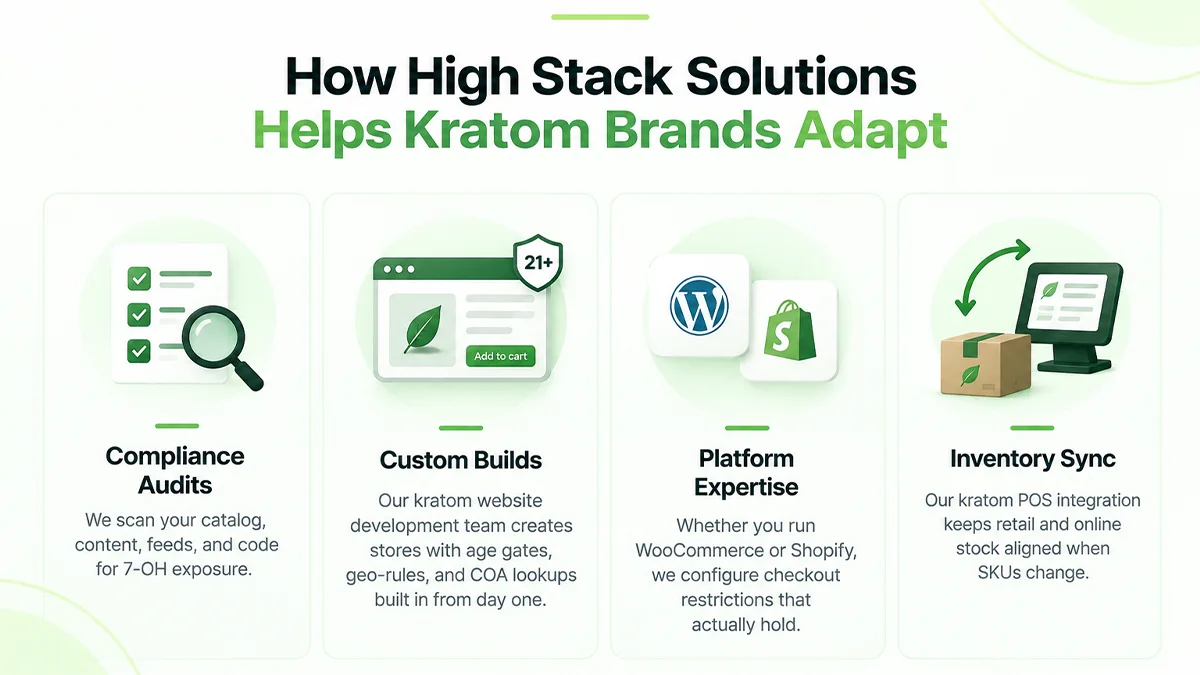
High Stack Solutions build and maintain eCommerce stores for Kratom, CBD, and Delta brands, so regulatory shifts like this are part of our everyday work. Here is how we help:
- Compliance audits: We scan your catalog, content, feeds, and code for 7-OH exposure.
- Custom builds: Our kratom website development team creates stores with age gates, geo-rules, and COA lookups built in from day one.
- Platform expertise: Whether you run WooCommerce or Shopify, we configure checkout restrictions that actually hold.
- Inventory sync: Our kratom POS integration keeps retail and online stock aligned when SKUs change.
For a broader view, read our guide to custom website development for high-risk niches, or revisit the basics in our starter guide to selling kratom online.
Not sure where your store stands? Book a free strategy call and we’ll walk through your site together. No pitch, no pressure, just a clear plan.
Conclusion
The 7-OH ban isn’t one single event. It’s a chain of federal and state actions that has already outlawed MP, MGM-15, and MGM-16, placed concentrated 7-OH one publication away from Schedule I, and pushed states like Tennessee and Massachusetts to ban kratom entirely.
For kratom sellers, the path forward is clear. Pull covered products, scrub 7-OH language from every corner of your site, retire old pages the SEO-safe way, and upgrade your geo-blocking and age verification. Back it all up with finished-product COAs, careful claims, and a payment setup that can survive scrutiny.
Most importantly, build your kill switch now. When the next order drops, you’ll act in minutes instead of scrambling for days. Compliant brands won’t just survive this reset. They’ll earn the customers others leave behind.
Frequently Asked Questions
Is 7-OH getting banned?
Yes, most likely. The DEA filed notice to place 7-OH above a 0.05% or 1 mg threshold into Schedule I. As of late September 2026, that order remains pending and could publish any day.
Is 7-OH legal in United States?
Concentrated 7-OH is not federally scheduled yet, but many states ban it. Florida, Tennessee, and Massachusetts are examples. Always check state and local law before selling or shipping.
When does the 7-OH ban take effect?
No date is set. The order takes effect the day it publishes in the Federal Register, with no grace period. The earliest possible date, August 5, 2026, has already passed.
Will the 7-OH ban affect regular kratom?
Not federally. Botanical kratom leaf below the 0.05% 7-OH threshold is excluded. However, states like Tennessee and Massachusetts now ban all kratom, including natural leaf.
What is the DEA threshold for 7-OH?
The proposed threshold is more than 0.05% 7-OH by dry weight in plant material, or more than 0.05% or 1 mg per article in synthetic and processed products.
What states have banned 7-OH?
States with full kratom bans, including Alabama, Arkansas, Indiana, Tennessee, Vermont, and Wisconsin, ban 7-OH too. Florida bans concentrated 7-OH specifically. Laws change quickly, so verify current statutes.
Can I still sell kratom online after the 7-OH ban?
Yes, in states where kratom remains legal. Sell only compliant leaf-based products, block restricted locations, verify ages, publish batch COAs, and avoid health claims to protect your store.