If you sell hemp-derived THC online, the past few weeks probably felt like whiplash. A Senate vote, a House vote, a presidential signature, and suddenly your compliance calendar has two dates on it instead of one. When your inventory, ad budget, and payroll ride on getting this right, confusion gets expensive fast.
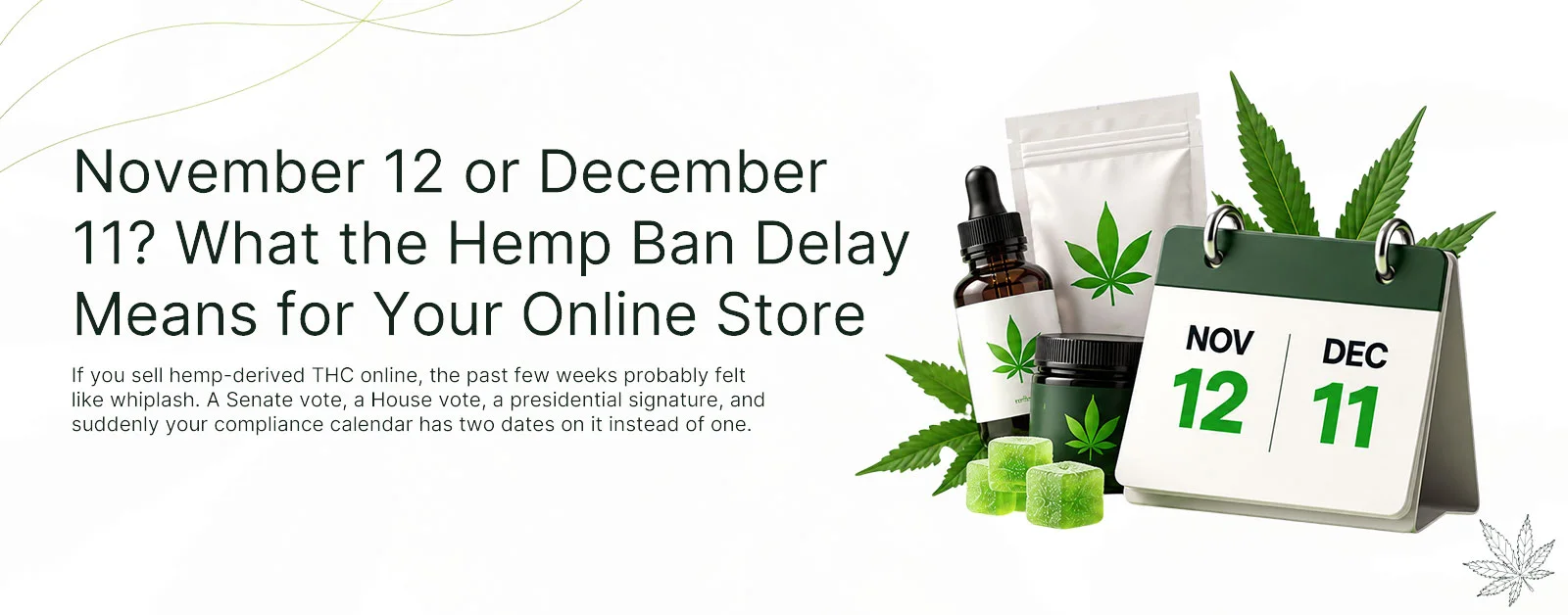
The hemp ban delay moved most federal hemp restrictions from November 12 to December 11, 2026, after President Trump signed H.R. 6500 on September 2. That includes the total THC rule and the 0.4 mg per container cap. One piece did not move: products with cannabinoids the plant cannot naturally produce still lose hemp status on November 12. Plan your store around both dates.
In this blog, we break down everything you need to know about the new hemp ban, which date applies to which products, what changes when each deadline hits, and the exact website updates to make before either one arrives.
DISCLAIMER: This article is for general information only and is not legal advice. Talk to a qualified hemp attorney about your specific products and states where your business operations occur.
What Is the Hemp Ban Delay?
The hemp ban delay is a short extension Congress tucked into a government funding bill. It pushes back most of the new federal hemp rules by 29 days. It does not repeal those rules, soften them, or replace them with a regulatory framework.
Think of it as a snooze button, not a cancellation. The underlying law stays exactly the same.
Where the Ban Came From
On November 12, 2025, President Trump signed Public Law 119-37 to end the fall government shutdown. Section 781 of that law rewrote the federal definition of hemp and gave the industry a one-year runway before enforcement.
The new definition does three big things:
- It measures hemp by total THC, which expressly includes THCA, instead of delta-9 THC alone.
- It caps finished hemp-derived cannabinoid products at 0.4 mg of total THC per container.
- It excludes cannabinoids that are synthesized or manufactured outside the cannabis plant.
The U.S. Hemp Roundtable estimates the new definition disqualifies roughly 95% of hemp cannabinoid products on the market today. That puts pressure on an industry valued at about $28.3 billion a year. For the full background, read our guide to the November 2026 Federal Hemp Ban.
How the Delay Became Law
The White House asked Congress to fold a delay into the stopgap spending bill, H.R. 6500, the Continuing Appropriations and Extensions Act, 2027. Here is how it moved:
- August 8, 2026: The Senate voted 61 to 32 to table Sen. Ted Budd’s amendment to strip the delay, then passed the bill 90 to 6.
- September 1, 2026: The House passed the bill 370 to 48, sending it to the president.
- September 2, 2026: President Trump signed H.R. 6500 into law.
Section 2019 of H.R. 6500 ties the new hemp deadline to the same day the stopgap funding runs out: December 11, 2026. That detail matters, and we will come back to it.
| Date | What Happens |
|---|---|
| November 12, 2025 | Section 781 becomes law with a one-year transition period. |
| February 10, 2026 | FDA deadline to publish its list of naturally occurring cannabinoids (missed). |
| August 8, 2026 | Senate passes H.R. 6500 with the hemp delay, 90 to 6. |
| September 1, 2026 | House passes H.R. 6500, 370 to 48. |
| September 2, 2026 | President Trump signs the hemp ban delay into law. |
| November 12, 2026 | Cannabinoids the plant cannot naturally produce lose federal hemp status. |
| December 10, 2026 | Last day of the current 0.3% delta-9 THC standard. |
| December 11, 2026 | Remaining Section 781 rules take effect. Government funding also expires. |
November 12 vs December 11: Which Date Applies to Your Products?
Here is where most headlines get it wrong. The hemp ban delay does not apply evenly across every product. Section 781 excludes two separate groups of cannabinoids, and Congress only delayed one of them.
Products That Still Face November 12
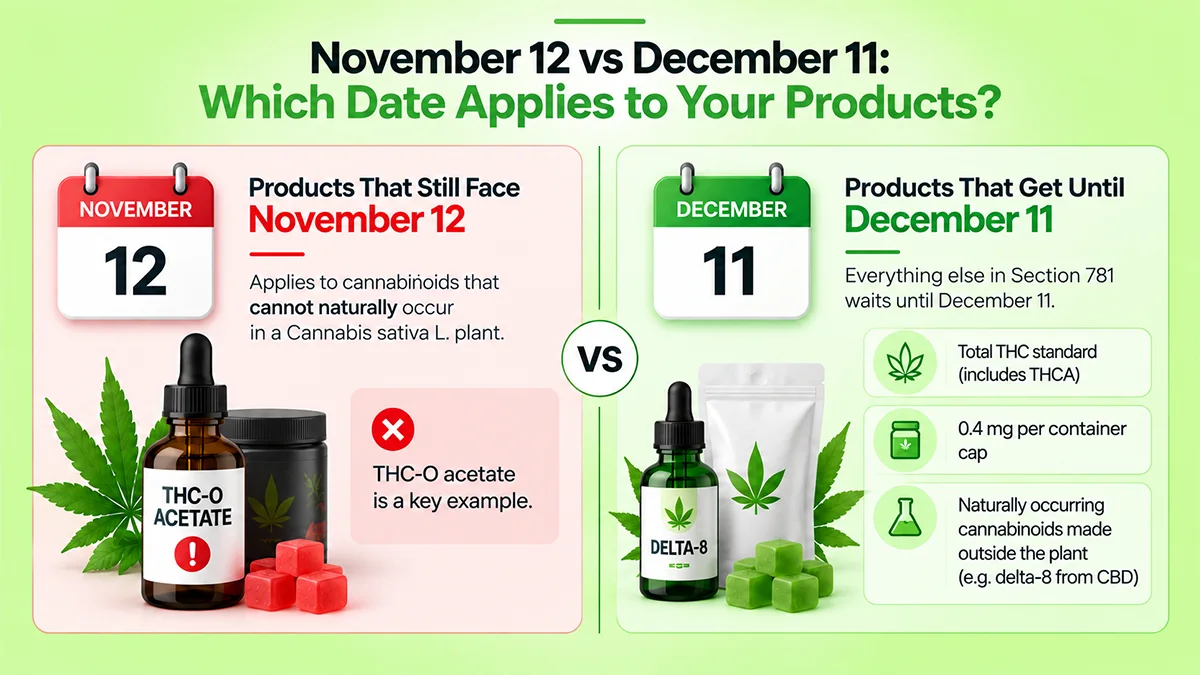
Starting November 12, the new rules apply to hemp products containing cannabinoids that a Cannabis sativa L. plant cannot naturally produce at all. Cannabis attorney Rod Kight points out that Congress did not postpone this restriction on truly synthetic cannabinoids.
THC-O acetate is the clearest example many online shops still carry. If a product’s active ingredient does not exist in nature, treat November 12 as your hard stop.
Products That Get Until December 11
Everything else in Section 781 waits until December 11. That includes:
- The total THC standard that counts THCA
- The 0.4 mg per container cap on finished products
- The exclusion for naturally occurring cannabinoids made outside the plant, such as delta-8 converted from CBD
Kight also notes that the current 0.3% delta-9 THC standard stays in place through December 10. So the rules your store follows today keep working until then, for most products.
The Delta-8 Gray Zone Most Guides Miss
You will find sites claiming converted delta-8 dies on November 12 and others saying December 11. Both are reading the same statute. The difference comes down to one unanswered question: which cannabinoids is the plant capable of producing?
The cannabis plant does make delta-8, just in tiny amounts. That is why mg Magazine and most hemp attorneys place delta-8 and THCV in the December 11 group, even when brands produce them through conversion.
Congress told the FDA to settle this. Section 781 required the agency to publish a list of naturally producible cannabinoids within 90 days, which meant by February 10, 2026. According to the Congressional Research Service, that list still had not appeared as of August 2026.
Our practical take: compounds like HHC and THCP sit in murkier territory than delta-8. If a SKU depends on a novel or semi-synthetic cannabinoid, plan to pull it by November 12 unless your attorney clears it in writing. Losing four weeks of sales costs far less than a seized shipment.
| Product Type | Federal Deadline | What to Know |
|---|---|---|
| THC-O acetate and other cannabinoids the plant cannot make | November 12, 2026 | Not covered by the delay. |
| HHC, THCP, and other novel cannabinoids | Unclear (plan for November 12) | Depends on the FDA list, which is still unpublished. |
| Delta-8 converted from CBD | December 11, 2026 (majority legal view) | Some sources say November 12. Confirm with counsel. |
| THCA flower, pre-rolls, and plant-derived THCA vapes | December 11, 2026 | Total THC standard applies from this date. |
| Hemp-derived delta-9 gummies and beverages | December 11, 2026 | Most exceed the 0.4 mg per container cap. |
| Full-spectrum CBD oils and tinctures | December 11, 2026 | Many carry enough trace THC to fail the cap. |
| CBD isolate and broad-spectrum products | Likely unaffected | Stay compliant if total THC is 0.4 mg or less per container. Verify with current COAs. |
Is Delta 8 Still Legal Right Now?
Yes, at the federal level, for now. Hemp-derived delta-8 still falls under the current 0.3% delta-9 THC definition, as long as your state allows it.
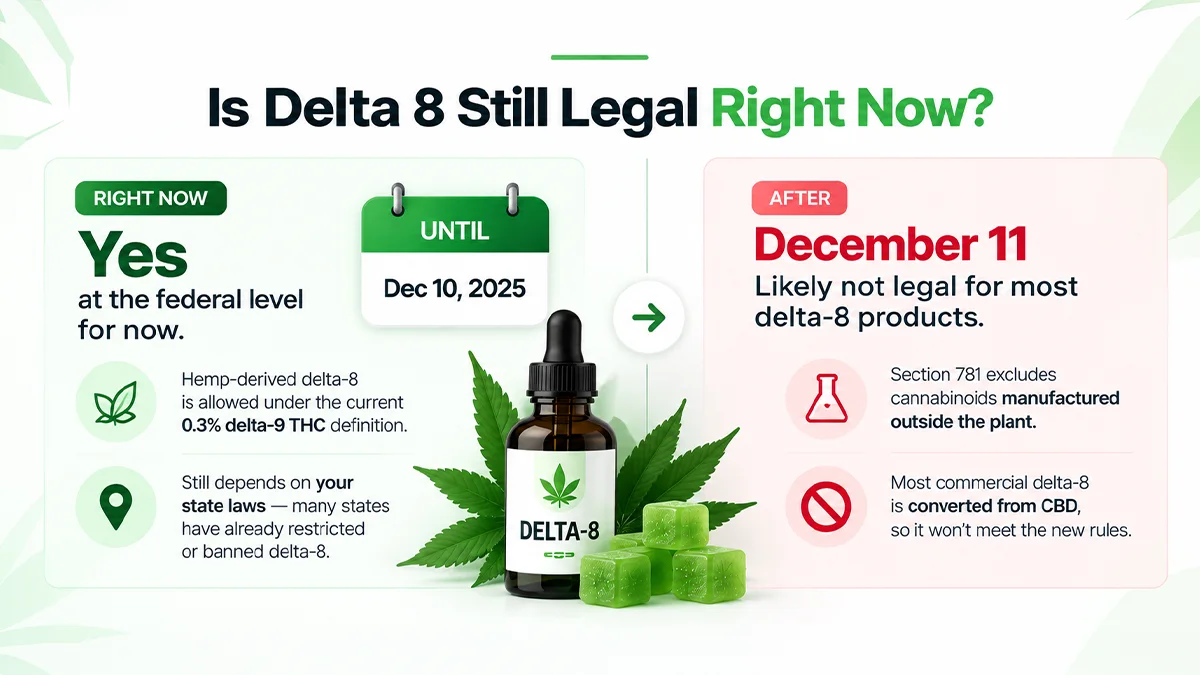
But the calendar matters more than the dose here. Once the new definition applies, Section 781 excludes cannabinoids manufactured outside the plant. Since nearly all commercial delta-8 comes from converting CBD, dropping the dose to 0.4 mg will not save a converted delta-8 SKU.
State law is the other half of the answer to "is delta 8 still legal" in any given place. Many states restricted or banned delta-8 long before Congress acted, so check every state you ship to. If you need a refresher on the chemistry, our breakdown of delta-8 vs. delta-9 THC explains how these cannabinoids differ.
THCA Ban 2026: What Happens to THCA Flower, Pre-Rolls, and Vapes
THCA sellers got the most meaningful reprieve from the hemp ban delay. Under current law, THCA flower qualifies as hemp if its delta-9 THC stays at or below 0.3% on a dry weight basis. That changes on December 11.
- Total THC counts THCA: Once the new definition applies, THCA counts toward the limit. Most smokable THCA flower will not pass.
- Vapes and concentrates: Plant-derived THCA carts and live resin products get the December 11 date, but a typical cart holds far more than 0.4 mg of total THC.
- Some states moved first: Texas banned THCA flower starting March 31, 2026, and Ohio limited hemp THC sales to cannabis retailers as of March 20.
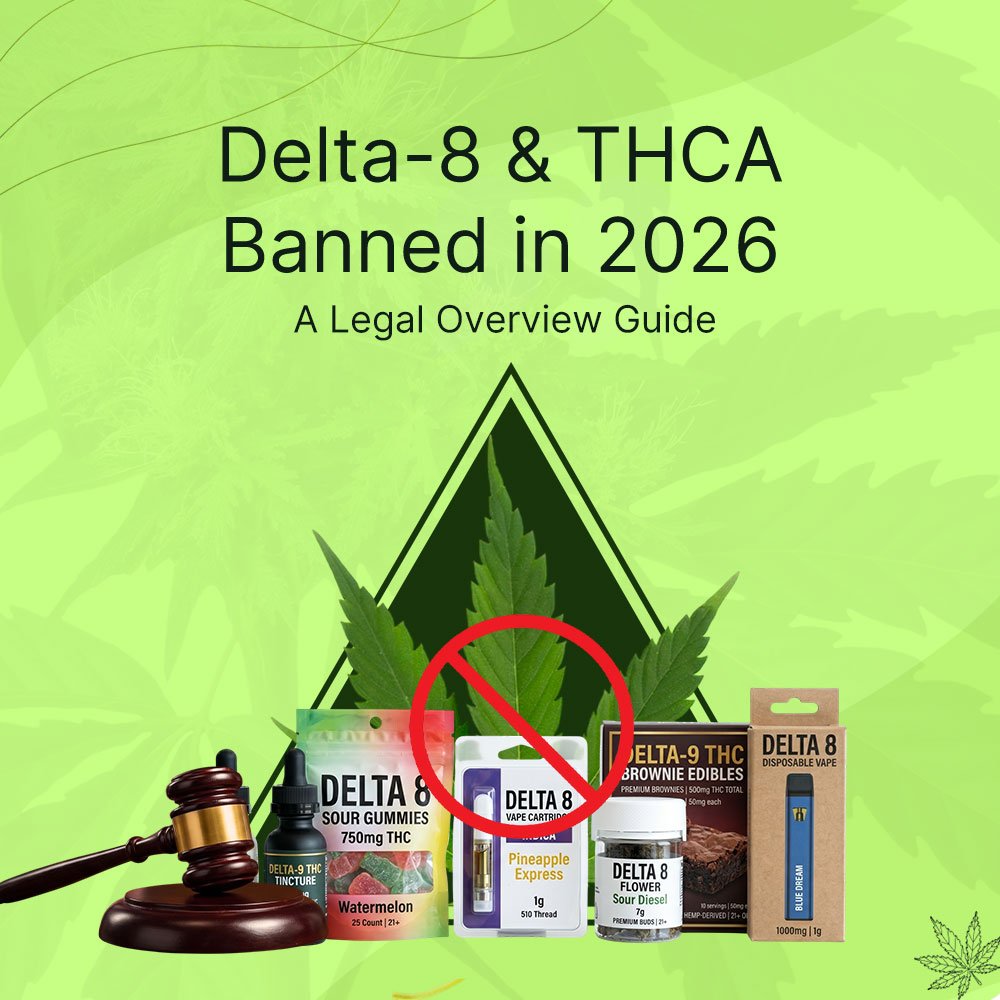
So the THCA ban 2026 deadline is December 11 federally, but it may already apply where your customers live. Our earlier guide, Delta-8 & THCA Banned in 2026: A Legal Overview, covers the background in more depth.
What Changes on the Hemp Ban December 11 Deadline
The hemp ban December 11 date is when the bulk of Section 781 finally bites. Here is what that looks like for an online seller.
The 0.4 mg Per Container Rule
The cap applies per container, not per serving. A 10-count tin of 5 mg gummies holds 50 mg of THC, which is 125 times the limit. Even many full-spectrum CBD tinctures carry enough trace THC to fail.
The FDA was also supposed to clarify what counts as a container. That guidance has not arrived either, so bundles, multipacks, and variety boxes deserve a close legal look. If you are unsure how your CBD formats compare, our guide to the different types of CBD explains full-spectrum, broad-spectrum, and isolate.
What Losing Hemp Status Means for Shipping
A product that fails the new definition no longer counts as hemp. Federally, it falls back under the marijuana rules of the Controlled Substances Act. Do not confuse this with the April 2026 rescheduling order, which moved only FDA-approved and state-licensed medical marijuana to Schedule III. Adult-use marijuana stays in Schedule I.
Shipping follows the same line. USPS allows hemp mailings only when products meet the legal definition of hemp and you keep compliance records, including lab results, for at least two years. Once a SKU stops being hemp, it stops being mailable.
What It Means for Payments
Most high-risk processors underwrite hemp merchants based on federal hemp status. If your catalog includes products that will not qualify after the deadline, your merchant agreement probably will not cover them either.
Call your processor now, not on December 10. Ask what documentation they need and whether they plan to review your account after the deadline.
Will There Be Another Hemp Ban Delay?
Maybe, but do not build your plan around it. Foley Hoag reports that White House legislative affairs director James Braid committed to no further extensions beyond December 11. Braid is leaving the administration, and that promise never became formal policy.
Lawmakers have introduced several bills to regulate hemp instead of banning it. Here is what is on the table:
- Rep. Andy Barr’s Lawful Hemp Protection Act, which would regulate manufacturing, labeling, and taxes with a 21+ age limit
- A draft from House Oversight Chair James Comer with packaging, testing, and age rules
- A bill from Reps. Beth Van Duyne and Greg Landsman to regulate hemp THC drinks like alcohol
- The Hemp Planting Predictability Act (H.R. 7024), which would push the effective date to
November 2028
None of these bills has cleared a committee. Meanwhile, 35 state and territory attorneys general urged Congress not to delay or weaken the ban.
Because the delay rides on the funding bill, December’s government funding fight becomes the next decision point for hemp. Watch that bill closely, but prepare as if December 11 is final.
What the Hemp Ban Delay Means for Your Online Store
Most articles stop at the legal dates. But your website is where compliance actually happens, or fails. These are the store-level details that trip up hemp brands.
Your Real Deadline Is the Delivery Date, Not the Checkout Date
An order placed on December 10 and shipped ground may still be in transit on December 13. That package is an avoidable risk.
Set a checkout cutoff several business days before each deadline, based on your slowest shipping method. Then show that cutoff clearly on product pages and in your cart so customers are not surprised.
Subscriptions, Automations, and Scheduled Emails
Your store keeps selling even when you stop thinking about it. Before each deadline, audit these:
- Subscription renewals scheduled after the cutoff
- Abandoned cart, win-back, and replenishment flows that feature affected SKUs
- SMS campaigns and scheduled promotions
- Inventory sync between your site and POS system, so an in-store change does not leave a live listing online
Our Automation for Delta team can rebuild these workflows so they respect each deadline automatically. If email drives a big share of your revenue, our email marketing guide for high-risk niches walks through compliant flows.
SEO: Do Not Just Delete Product Pages
Deleting hundreds of URLs overnight creates a wall of 404 errors and throws away years of rankings. Try this instead:
- 301 redirect retired products to the closest compliant alternative or category
- Update Product schema so availability reads as discontinued, not in stock
- Refresh blog posts that still cite November 12 as the only date
- Keep educational content live, but remove buy buttons for banned items
Google’s own guidance on helpful, people-first content rewards accurate, up-to-date pages. Stale legal dates on your site hurt trust with shoppers and with AI search tools that summarize your content.
State Laws Do Not Wait for Congress
Your geo-restriction rules need to work by state, by product, and by date. A good setup blocks checkout for restricted SKUs in restricted states while letting compliant products flow everywhere else.
Most off-the-shelf templates cannot handle that logic cleanly. Our guide to custom website development for high-risk niches explains why custom builds matter for regulated catalogs.
Hemp Ban Compliance Checklist for Your Website
Use this timeline to stay ahead of both dates and adjust it to your catalog size and shipping speeds.
| When | What to Do on Your Store |
|---|---|
| Now through mid-October | Audit every SKU and COA. Tag products by cannabinoid source and total THC per container. Book time with your hemp attorney. |
| Mid-October | Talk to your payment processor. Build scheduled unpublish rules. Pause subscriptions tied to at-risk SKUs. |
| Early November | Remove products with cannabinoids the plant cannot make, plus anything your counsel flags. Set shipping cutoffs and launch redirects. |
| Mid-November to early December | Update product copy, FAQs, age gates, and state blocking. Add compliant replacement SKUs with current COAs. |
| December 11 | Confirm every non-compliant listing is offline, product feeds are updated, and automations are paused. |
Your Three Paths Forward After the Hemp Ban Delay
Every hemp brand affected by the hemp ban delay ends up choosing among three routes. Each one requires real website work, so start planning now.
| Path | Best For | Website Work Involved |
|---|---|---|
| Reformulate | CBD and wellness brands that can stay at 0.4 mg total THC or less per container | New SKUs, fresh COAs, updated labels, and compliant product copy |
| Move into state-licensed cannabis | Brands with licensed partners or dispensary relationships | Geo-restricted menus, in-state fulfillment, and dispensary integrations |
| Pivot to adjacent categories | Brands that want to keep a national DTC store | New catalog, compliance copy, SEO migration, and new payment setup |
If you are reformulating CBD, our CBD website development team builds product pages around compliant COAs and claims. Pivoting into functional mushrooms? See our mushroom website development services.
How High Stack Solutions Helps Hemp Brands Beat Both Deadlines
At High Stack Solutions, we build and maintain stores for Kratom, CBD, Delta, and Cannabis brands every day, so we have tracked this law since the first draft. Our clients do not need generic advice. They need a store that keeps selling legally on November 13 and December 12.
Our Delta-8 & THCA Migration service was built for this exact moment:
- An audit of your catalog, state exposure, and deadline risk before anything moves
- Age verification, state-by-state geo-restriction, and compliant disclaimers built into your store
- High-risk payment gateways with a live backup, so one termination cannot freeze your checkout
- Products, customers, and orders migrated with 1:1 redirects to protect your rankings
After launch, our Delta web maintenance and support team keeps your store updated as rules shift. Want to see what we build? Browse our recent work.
Not sure where your store stands? Book a free 30-minute strategy call. You will talk directly with our founder and not a sales rep to get a clear update plan.
Conclusion
The hemp ban delay bought most hemp brands 29 extra days, not a new future. Products with cannabinoids the plant cannot produce still lose federal hemp status on November 12. Everything else, including the total THC standard, the 0.4 mg per container cap, and the exclusion for converted cannabinoids like delta-8, arrives on December 11, 2026.
Congress could still act in December, but the White House has signaled no more extensions, and no replacement bill has cleared committee. States like Texas and Ohio have already moved on their own.
The smart move is to treat December 11 as final and build your store around both dates now. Audit your SKUs, set delivery-based cutoffs, clean up automations, protect your SEO with redirects, and choose your path: reformulate, move into licensed cannabis, or pivot. Do it on your timeline, not the government’s.
Frequently Asked Questions
Has the hemp ban been delayed?
Yes. President Trump signed H.R. 6500 on September 2, 2026, moving most federal hemp restrictions from November 12 to December 11, 2026. The rule for non-natural cannabinoids still starts November 12.
When does the hemp ban take effect now?
Most restrictions take effect December 11, 2026. Products containing cannabinoids the cannabis plant cannot naturally produce, such as THC-O acetate, lose federal hemp status on November 12, 2026.
Is delta 8 still legal?
Federally, hemp-derived delta-8 remains legal under current rules until the new definition applies, likely December 11, 2026. After that, converted delta-8 loses hemp status. Many states already restrict it.
Will THCA flower be illegal after December 11?
Most THCA flower will no longer qualify as federal hemp on December 11, 2026, because the new total THC standard counts THCA. Some states, including Texas, banned it earlier.
What is the 0.4 mg per container rule?
Starting December 11, 2026, finished hemp-derived cannabinoid products can contain no more than 0.4 mg of total THC per container. The limit applies to the whole package, not each serving.
Does the hemp ban delay apply to CBD?
Yes. Full-spectrum CBD products fall under the December 11 date. Products with 0.4 mg or less of total THC per container, like many isolate and broad-spectrum items, can likely remain compliant.
Are hemp THC drinks still legal?
Federally, hemp-derived delta-9 beverages remain legal until December 11, 2026, if they meet current rules. After that, most exceed the 0.4 mg cap. State beverage laws vary widely.