Starting a peptide ecommerce business means building a compliant online store that sells research peptides such as BPC-157, TB-500, and GLP-1 class compounds under a strict research-use-only model. The real steps are simple to list but hard to skip: form your legal entity, choose WooCommerce instead of Shopify, lock down high-risk payment processing, put a Certificate of Analysis on every product page, and grow through SEO instead of paid ads.
This niche moves fast. The FDA changed how it treats several popular peptides in April 2026, and payment processors update their rules almost every quarter. If you searched how to start a peptide business and only found vague advice, this guide walks through every real step with current 2026 data, so your store actually stays online.
In this blog, we are going to guide you about the business and compliance side of selling research peptides. It is not medical, legal, or dosing advice. Talk to a qualified attorney and licensed professionals before you launch or use any peptide product.
What Is a Peptide Ecommerce Business, Exactly?
A peptide ecommerce business sells peptide compounds online, almost always labeled for research use only and not for human consumption. On paper, the buyer is a researcher or a lab. In practice, most customers are individuals interested in recovery, longevity, or body composition.
This is not a niche hobby market anymore. The global peptide therapeutics market reached roughly $140.9 billion in 2025 and is projected to nearly double by 2033, according to Grand View Research. That figure includes FDA-approved drugs like semaglutide, but it shows how much consumer demand is pouring into the whole peptide category, including the unapproved research-grade side most ecommerce brands actually sell.
Popular categories inside a typical peptide ecommerce business include:
- Recovery and healing peptides, like BPC-157 and TB-500
- Growth hormone secretagogues, like CJC-1295, ipamorelin, and sermorelin
- Metabolic and GLP-1 class compounds, like semaglutide and retatrutide
- Skin and anti-aging peptides, like GHK-Cu and epitalon
- Cognitive and nootropic peptides, like Semax and Selank
At High Stack Solutions, research peptides are one of the newest verticals we build for, right alongside Kratom, CBD, Delta, and Cannabis brands. The pain points are nearly identical across every one of these industries: a platform that will not host you, and a bank that will not process you.
Is It Legal to Sell Research Peptides Online?
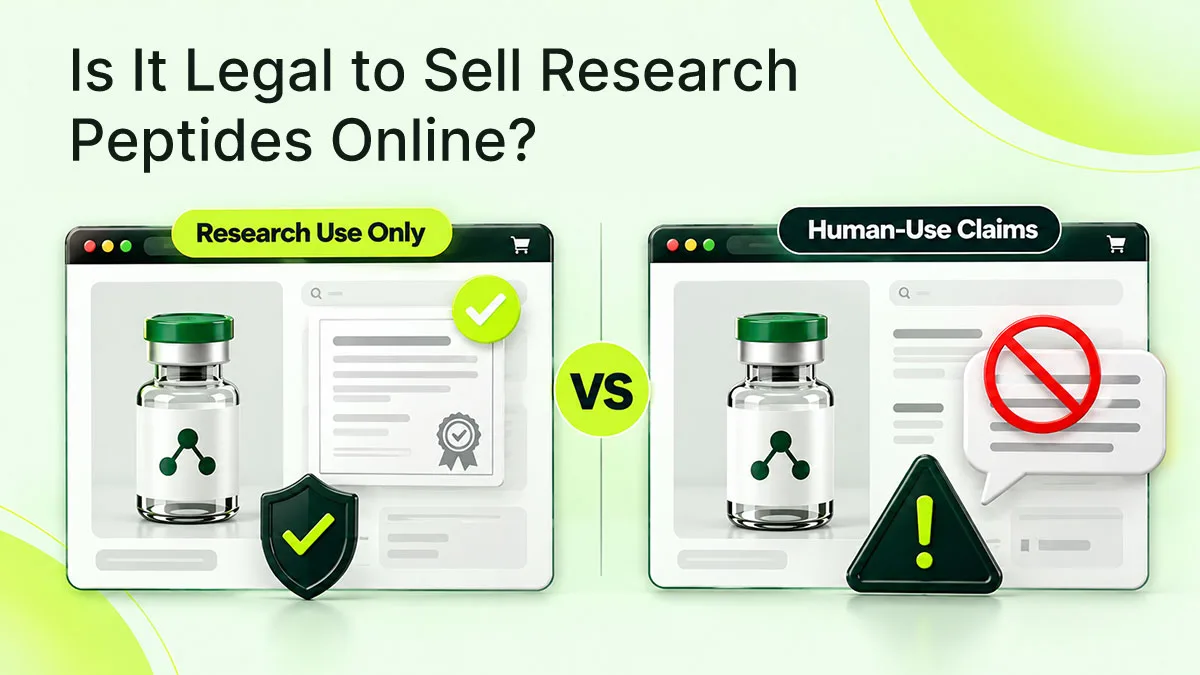
Short answer: yes, with real limits. Selling a peptide that is labeled and marketed strictly for laboratory research is legal in the United States. What crosses the line is selling an unapproved peptide with any hint that a person will inject or swallow it, or making a health claim about it.
The “Research Use Only” Framework
The FDA does not regulate peptides purely by chemical name. It regulates them by intended use. A peptide sold for legitimate laboratory research sits in a different legal bucket than the exact same molecule sold with dosing charts aimed at a human customer.
That is why the phrase not for human consumption shows up on almost every research peptide product page. It is a necessary disclaimer, but compliance guides across this industry agree it is not a magic shield. If your marketing, reviews, or product copy signal human use, the disclaimer alone will not protect the business.
Where the FDA Draws the Line
Peptides used in patient care generally fall under Section 503A or 503B of the Food, Drug, and Cosmetic Act, which cover pharmacy compounding. The FDA maintains a public list of bulk drug substances allowed in compounding, split into safety categories. Category 1 substances face no special restriction. Category 2 substances carry an identified safety concern that blocks compounding pharmacies from using them.
Research peptide ecommerce brands operate outside this compounding framework entirely. They are not pharmacies and are not dispensing to patients. That is exactly why the research-use-only positioning exists, and exactly why it has to be handled carefully.
The 2026 Regulatory Shakeup You Need to Know About
Here is the part most articles about this topic miss, because it happened this year. On April 15, 2026, the FDA removed BPC-157, TB-500, CJC-1295, and nine other peptides from Category 2 of its 503A bulk drug substances list, according to legal analysis from Holt Law. Category 2 is the list reserved for substances with an identified safety concern.
That sounds like good news, and in one sense it is. But removal from Category 2 did not move these peptides to Category 1, the actual approved list. None of them are FDA-approved, and none have a recognized USP or NF monograph. They are sitting in a genuine gray zone while the FDA’s Pharmacy Compounding Advisory Committee reviews several of them at a meeting scheduled for July 23 and 24, 2026.
Enforcement has not slowed down while this plays out. Peptide Sciences, once a major supplier for clinics and individual buyers, shut down in March 2026 under sustained federal pressure. Separately, a large 503B compounding facility, Tailor Made Compounding, forfeited $1.79 million in a federal case, per reporting from Spartacus Law Firm. Treat the April 2026 change as a shift in tone, not a green light.
This is exactly why step one of building a peptide ecommerce business is never the website. It is the legal groundwork underneath it.
Step 1: Build Your Legal and Compliance Foundation First
Here is how to start a peptide business without the guesswork, one solid step at a time.
- Form an LLC or corporation before you take a single order. A chargeback dispute or a product-quality claim against a sole proprietorship puts personal assets at risk.
- Get an EIN and open a dedicated business bank account. Mixing personal and business funds makes high-risk underwriting harder later.
- Hire an attorney who understands FDA intended-use law to draft your research-use-only disclaimer from scratch. Do not copy a competitor’s wording.
- Ask about product liability coverage early. Carriers comfortable with research-use-only peptide sales are limited, so start the search before launch, not after a claim.
Step 2: Choose Your Peptide Product Catalog
Most founders in this niche run a white-label model. A manufacturer produces, tests, and stores the peptides. You own the brand, the storefront, and the customer relationship, and orders ship under your label.
- Require an independent, third-party Certificate of Analysis (COA) for every batch, covering both purity and identity testing.
- Avoid single-sourcing. Qualify at least two manufacturers so one supplier problem does not take your whole catalog offline.
- Stay especially cautious with GLP-1 class compounds like semaglutide and retatrutide. This category currently faces the heaviest FDA and card-network scrutiny of any peptide segment.
- Keep your SKU count manageable at launch. A tight, well-documented catalog builds more trust than a huge one with inconsistent testing.
Step 3: Pick the Right Ecommerce Platform
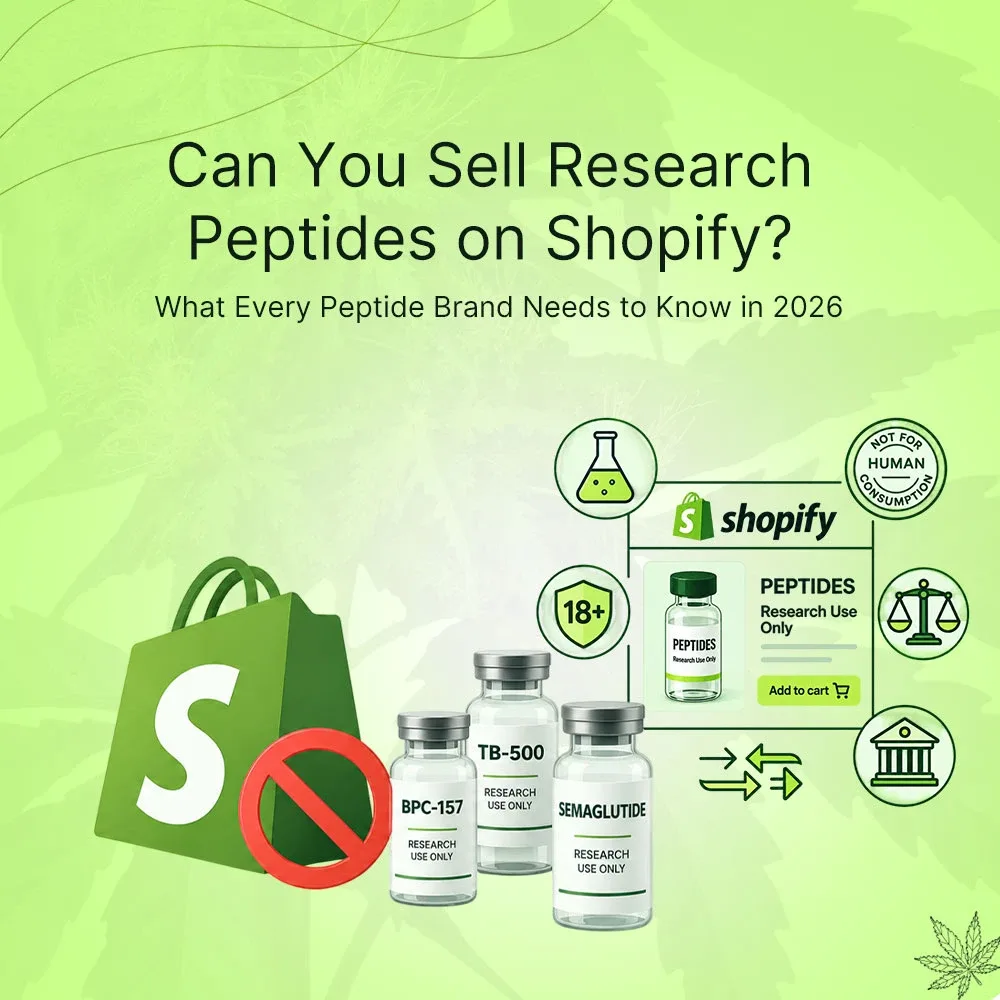
This decision is barely a choice. Shopify’s Acceptable Use Policy explicitly bans peptides, research chemicals, and pseudo-pharmaceuticals, no matter how a store labels or disclaims them. Shopify’s own trust and safety systems scan product titles, descriptions, and even checkout metadata for flagged terms, and enforcement can freeze funds without warning.
WooCommerce is the practical default for this reason alone. It is self-hosted, so no platform-level product ban can shut you down overnight, and it connects to the high-risk payment gateways built specifically for this industry.
| Factor | WooCommerce | Shopify |
|---|---|---|
| Allows peptide sales | Yes, self-hosted with your own policies | No, banned under the Acceptable Use Policy |
| Payment gateway flexibility | Open, connects to high-risk gateways | Locked to Shopify Payments and its Stripe-based rules |
| Shutdown risk | Low, no platform-level product scan | High, automated keyword and product scanning |
| Setup effort | Higher, needs proper hosting and security | Lower, but not usable for this niche |
If you want a partner who already knows this territory, High Stack Solutions builds research peptide website development from the ground up, with age gates, disclaimers, and COA displays baked in from day one.
Step 4: Solve Payment Processing Before You Launch
This is where most first-time founders get stuck. Banks and card networks treat peptides as high risk because of chargeback exposure and regulatory uncertainty. Expect a rolling reserve of 5 to 15 percent of sales, often held for 90 to 180 days, per payment industry data from SeamlessChex.
| Processor | LegitScript Required | Good Fit For |
|---|---|---|
| PeptiPay | No | Peptide-specific WooCommerce stores wanting fast setup |
| AllayPay | No | Domestic U.S. startups selling research-use-only peptides |
| Easy Pay Direct | Yes | Established merchants wanting long-term rate stability |
| Corepay | Varies | Sellers wanting fast preapproval plus offshore backup |
Processor details current as of 2026, per onPoint Studio’s payment gateway roundup. Terms and approval odds change often in this category, so confirm current requirements directly with each provider.
Do You Need LegitScript Certification?
Not always, but plan for it. LegitScript certification is not legally mandatory for straightforward research-only sales, but it is increasingly the gatekeeper for running Google or Meta ads in this category, and some processors require it outright, according to GivePayments’ certification guide. Certification review typically takes several weeks, so apply well before you plan to advertise.
Never rely on a single processor. If one account gets flagged, a backup gateway keeps revenue flowing while you sort out the issue.
Step 5: Build Compliance Into Every Page
Compliance is not a footer link you add once and forget. It has to live on every page a customer touches.
- Put the research-use-only disclaimer on the homepage, every product page, and the checkout screen, with a checkbox the customer must actively confirm.
- Display or link the COA for every product, not just a generic statement that says you test your products.
- Add age verification at checkout. Many processors and states expect an 18-plus or 21-plus gate for this category.
- Cut any dosing chart, before-and-after photo, or disease claim from your copy. These are the fastest way to turn a research chemical into an unapproved drug in the FDA’s eyes.
If you want the full playbook for building a compliant storefront in a high-risk category, our ultimate guide to custom website development for high-risk niches walks through the technical side in more depth.
Step 6: Design for Trust, Not Just Looks
Peptide buyers are skeptical by default, because so many storefronts in this space look identical and disappear within a year. Your design has to earn trust fast.
- Put COA badges and third-party testing data above the fold on product pages, not buried in a PDF link nobody clicks.
- Keep page load times fast. A slow, generic-feeling store reads as low-trust in this category.
- Show a real return and refund policy. Vague policies are a red flag buyers in this niche have learned to spot.
- Skip stock photography of pills and syringes. Real product shots and lab documentation convert better.
This is exactly the kind of build our team handles through research peptide WooCommerce store development, where compliance features are part of the design from the first wireframe, not bolted on afterward.
Step 7: Plan Fulfillment, Shipping, and Inventory
Most lyophilized, or freeze-dried, research peptides are shelf-stable at room temperature, but always confirm storage requirements with your specific manufacturer since some formulations still need refrigeration.
- Use discreet, professional packaging. Discreet does not mean deceptive about what the package contains.
- Check state-level shipping restrictions before you expand your service area. A handful of states and localities restrict specific compounds.
- Sync inventory to the exact COA batch you are shipping. If a batch changes, your product page and paperwork need to change with it.
Keeping orders, batches, and testing records tied together gets much easier with proper peptide POS integration connected to your storefront.
Step 8: Set Up Subscription and Retention Systems
Repeat purchases drive most of the profit in this niche, the same way they do in supplements. A customer who reorders every 30 to 60 days is worth far more than a one-time buyer.
- Automate reorder reminders based on typical usage cycles for each product line.
- Segment your email list by product category so messaging stays relevant and compliant.
- Track churn by SKU. If one product line loses subscribers fast, treat it as a signal to check quality or messaging.
Our automation for research peptides service builds these reorder flows directly into WooCommerce, so retention runs on autopilot instead of manual follow-up.
Step 9: Market a Peptide Ecommerce Business Without Getting Banned
Paid ads are the hard way into this niche. Google and Meta both restrict peptide and supplement-adjacent advertising, and an unapproved campaign can get your entire ad account suspended, not just the one ad.
SEO and content marketing carry far less platform risk, and they compound over time. Google’s own guidance on creating people-first, genuinely helpful content rewards exactly the kind of specific, well-sourced information buyers in this niche search for, like compliance requirements, platform comparisons, and payment setup guides.
- Publish real how-to content around platform choice, compliance, and payment setup, the questions your buyers are already typing into Google.
- Build an email list from day one. It is the one channel a payment processor or ad platform cannot take away from you.
- Get featured in industry directories and supplier reviews. Trust signals matter more here than in almost any other ecommerce category.
If email is a weak spot in your current setup, our ecommerce email marketing guide for high-risk niches covers deliverability and compliance issues specific to regulated products.
Common Mistakes That Get Peptide Stores Shut Down
- Copying a competitor’s disclaimer word for word instead of having one drafted for your specific catalog
- Running paid social ads before checking the platform’s health and wellness ad policy
- Relying on a single payment processor with no backup gateway in place
- Letting a customer review or testimonial imply a specific human outcome
- Skipping COA testing on a new supplier batch to save money
- Trying to launch on Shopify because setup looks faster, then losing the store weeks later
How Much Does It Cost to Start a Peptide Ecommerce Business?
Budgets vary widely, but most founders land somewhere in a predictable range once legal, website, inventory, and payment setup are all accounted for.
| Cost Category | Estimated Range |
|---|---|
| Business formation and legal disclaimer drafting | $1,500 to $5,000 |
| Custom WooCommerce build with compliance features | $4,000 to $15,000 or more |
| Initial inventory and COA testing | $3,000 to $10,000 |
| LegitScript certification (optional) | $1,075 or more per year |
| Ongoing hosting, maintenance, and SEO | $300 to $1,500 per month |
Rolling payment reserves add another layer. Expect processors to hold 5 to 15 percent of revenue for several months while your account builds a track record.
Peptide Ecommerce Business Startup Checklist
Here is everything you must check before getting your research peptide business online:
- Legal entity, EIN, and attorney-drafted research-use-only disclaimer in place
- WooCommerce site built with age gate, disclaimers, and COA display
- Backup high-risk payment processor secured, not just a primary gateway
- COA-tested inventory sourced from at least one qualified manufacturer
- SEO content and an email list started before launch day
- LegitScript application submitted if paid ads are part of your plan
Conclusion
Building a peptide ecommerce business in 2026 comes down to sequencing. Get the legal and compliance foundation right first, choose WooCommerce over Shopify, lock in a high-risk payment processor with a backup, and put COAs and disclaimers on every page a customer sees. Skip any one of those steps and you are building on sand, no matter how good the storefront looks.
The regulatory ground under this industry is still shifting, from April 2026’s Category 2 changes to the Pharmacy Compounding Advisory Committee review scheduled for July. You should follow this guide as your starting checklist, not legal advice, and pair it with a real conversation with an attorney and a compliance-aware development partner.
If you want a team that already understands everything from platform to payment gateway to design and development, book a free strategy call with High Stack Solutions and we will lay out exactly what your peptide ecommerce business needs to launch and stay online.
Frequently Asked Questions
Is it legal to sell research peptides online in the US?
Yes, if the peptides are marketed strictly for laboratory research with no human-use claims. Marketing or selling in a way that implies human self-administration is treated as distributing an unapproved drug.
Do I need a license to start a peptide ecommerce business?
No special federal license exists for research-use-only peptide sales, but you still need a standard business license, EIN, and state sales tax registration like any other ecommerce company.
Can I sell peptides on Shopify?
No. Shopify’s Acceptable Use Policy bans peptides outright, regardless of disclaimers or labeling. Selling peptides on Shopify risks account termination and frozen funds.
What ecommerce platform is best for a peptide ecommerce business?
WooCommerce is the industry standard. It is self-hosted, so no platform can ban your product category, and it connects to high-risk payment gateways built for peptides.
Is BPC-157 legal to sell as a research peptide in 2026?
BPC-157 was removed from the FDA’s restricted Category 2 list in April 2026, but it remains unapproved and outside Category 1, so strict research-only marketing still applies.
Why do payment processors keep shutting down peptide stores?
Banks and card networks classify peptides as high-risk due to chargeback rates and regulatory uncertainty. Most processors freeze funds for 90 to 180 days after a shutdown.
How do I market a peptide ecommerce store without violating ad policies?
Focus on SEO, organic content, and email marketing. Google and Meta both restrict peptide-related paid ads, and a rejected campaign can get your whole ad account banned.