Selling products online in a high risk niche like CBD or Kratom can be lucrative. But when it comes to developing the marketing campaign for such products, the options are pretty limited. Even with the most direct yet effective approach, like email marketing becomes questionable due to a number of reasons, and let us show you why.
E-commerce email marketing for high risk niches means building and monetizing an owned subscriber list for age-restricted products that ad platforms refuse to promote. Because CBD, kratom, delta, vape, and nicotine brands cannot rely on paid traffic, email carries the revenue. It works when you pair a permissive email service provider with compliant opt-ins, authenticated sending, tight segmentation, and education-led flows instead of hard health claims.
In this blog, we are going to break down the platforms that will not drop you, the sending setup that keeps you out of spam, the flows that drive repeat revenue, and the language that keeps regulators off your back.
What Counts as a “High Risk” Niche in eCommerce?
“High risk” is not a judgement about your product. It is a label that payment processors, ad networks, and software vendors apply to any category where the legal status changes by state, by country, and sometimes by month.
In practice, the high risk bucket for online retail includes:
- CBD and hemp-derived wellness products such as tinctures, topicals, and gummies
- Kratom powders, capsules, extracts, and shots
- Delta-8, Delta-9, Delta-10, and THCA edibles, vapes, and flower
- Vape hardware and e-liquid, including disposables
- Nicotine pouches and other smokeless nicotine products
- Functional mushrooms and other grey-area supplements
What links them is not chemistry. It is friction. You get age gates, restricted checkout options, shipping limits, an FDA that watches your claims, and a marketing stack that can revoke your account with 30 days’ notice. If you are still deciding which of these categories to build in.
The upshot: in a normal niche, email is one channel among many. In a high risk niche, email is closer to infrastructure.
Why is Email the Most Reliable Growth Channel for High Risk Brands?
Meta and Google both prohibit paid promotion of CBD and cannabis-derived products. Amazon bans them outright. TikTok will pull a shop with no warning. Every follower you build on a social platform is rented, and the rent can go up or the landlord can evict you.
An email list is different. The addresses sit in your database. If your ESP drops you, you export the list and move. If a platform changes its policy, your subscribers do not disappear. That structural difference is why high risk operators consistently see email produce a larger share of revenue than mainstream stores do.
The economics back it up. Litmus puts the average return on email marketing at $36 for every $1 spent, the highest of any digital channel it benchmarks, and retail and eCommerce brands land higher still. Now subtract the paid channels a hemp brand cannot legally use, and email stops being a “nice to have” line item.
There is a timing argument too. Under Section 781 of the FY2026 appropriations act, the federal definition of hemp narrows on November 12, 2026, capping finished hemp-derived products at 0.4 mg of total THC per container. If your catalog has to be reformulated, repositioned, or replaced, the list is the asset that survives the transition. We covered the details in our guide to the November 2026 federal hemp ban.
Which Email Platforms Actually Allow CBD, Kratom, and Vape Brands?
This is the question that decides everything downstream, and the answer is more nuanced than most listicles admit. The big split is email versus SMS.
Email policies are set by the ESP. SMS policies are set by the mobile carriers, and carriers enforce the SHAFT rules (Sex, Hate, Alcohol, Firearms, Tobacco). Klaviyo’s own acceptable use policy prohibits SMS content related to CBD, cannabis, kratom, vaping, e-cigarettes, and THC, even while permitting compliant email for some of those categories. So a platform can be a great email partner and a dead end for texting, at the same time.
| Platform | Typical stance on hemp/CBD email | Typical stance on kratom, vape, nicotine | Best for |
|---|---|---|---|
| Klaviyo | Generally permitted for compliant, legally sold products | Restrictive. Kratom brands were offboarded in 2024. SMS blocked under SHAFT | Established CBD stores that need deep Shopify data |
| Omnisend | Widely used by hemp and vape retailers | Vape retailers use it successfully. SMS still carrier-restricted | Mid-market stores wanting email plus flows in one tool |
| Sendlane | Openly cannabinoid-friendly | Case by case. Ask before migrating | Brands that want a written yes before they build |
| Drip / Moosend / MailerLite | Generally permissive | Varies by product and jurisdiction | Smaller lists and simpler automation needs |
| Mailchimp | Vague. “Illegal goods” clause creates grey area | Risky. Many suspensions reported | Honestly, not this category |
| Self-hosted (Ongage, SMTP relay) | You set the rules | You set the rules | High-volume senders who have been burned before |
Policies change without notice, so treat this as a starting point, not gospel. Read the acceptable use policy yourself, in writing, before you migrate a single contact.
What Happened When Klaviyo Dropped Kratom Brands?
In 2024, Klaviyo notified kratom merchants that their accounts would be closed, giving roughly 30 days to export their data before lockout. Brands that had built every flow, every segment, and every template inside one platform suddenly had a month to rebuild their revenue engine.
The lesson is not “avoid Klaviyo.” The lesson is portability. Export your list monthly. Document your flows outside the platform. Keep your sending domain under your own DNS control so you can point it at a new provider without warming from zero. Treat your ESP as a rented tool and your list as owned property, and a policy change becomes an inconvenience instead of an extinction event.
How Do You Build an Email List When You Cannot Run Ads?
Without paid acquisition, every visitor is expensive to earn and cheap to lose. So the on-site capture layer has to work far harder than it does for a normal DTC store.
Age gate as a capture point. Your compliance requirement is also your best asset. The visitor is already confirming they are 21+. Add an email field with a first-order incentive and you convert a legal formality into a subscriber.
Exit-intent and scroll-triggered popups. A well-built popup on a high risk store commonly converts 6% to 10% of visitors, and well-optimized ones do considerably better. This is where your first-purchase discount belongs.
Checkout and post-purchase. Consent checkbox at checkout, then a follow-up on the thank-you page offering the COA (Certificate of Analysis) for the exact batch they bought. Nobody in this category refuses a lab report.
Education gates. Dosage guides, strain comparisons, and beginner explainers are natural lead magnets because your buyers genuinely research before purchase.
In-pack QR codes. Every shipment is a reacquisition opportunity. Print a QR that links to a reorder page with an embedded signup.
Where this typically breaks is the technical layer. Popups that fire before the age gate, consent that never syncs to the ESP, or a WooCommerce setup that drops the subscriber tag. If you are still choosing a foundation, learn about the comparison between website builders for CBD products covers which platforms handle this cleanly.
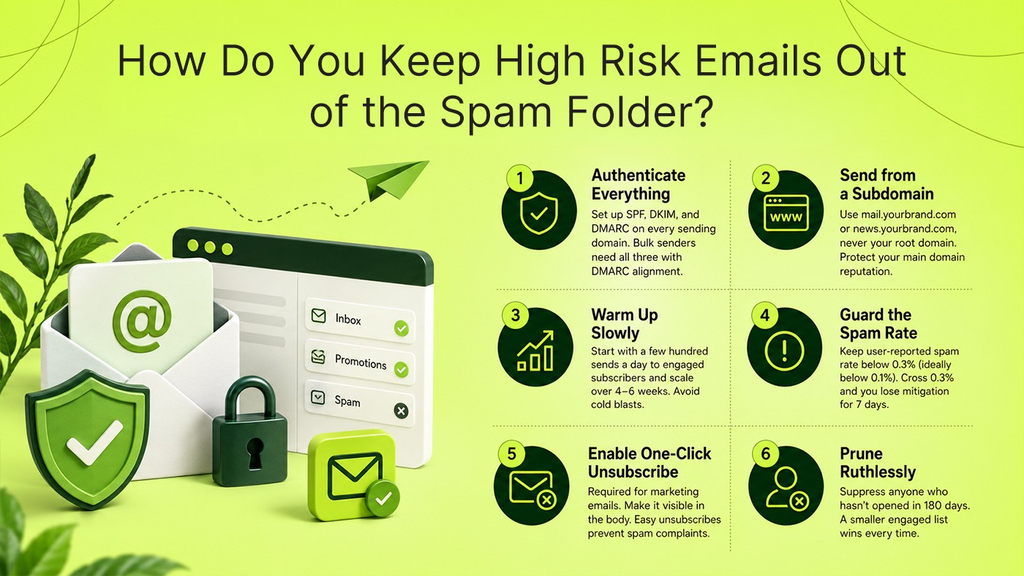
How Do You Keep High Risk Emails Out of the Spam Folder?
Deliverability is where most high risk programs quietly bleed money. Your content can be perfect, but if Gmail decides you are a spammer, none of it matters.
Google’s email sender guidelines now apply real consequences, and as of November 2025 Gmail escalated to temporary and permanent rejections for non-compliant traffic, not just spam-foldering. Here is the setup that keeps you inboxed:
Step 1: Authenticate everything. SPF, DKIM, and DMARC on every sending domain. Bulk senders (5,000+ messages a day to Gmail) need all three, with DMARC alignment. This is non-negotiable.
Step 2: Send from a subdomain. Use mail.yourbrand.com or news.yourbrand.com, never your root domain. If reputation tanks, your transactional email and your corporate mail survive.
Step 3: Warm up slowly. Start at a few hundred sends a day to your most engaged subscribers, then scale over 4 to 6 weeks. A cold blast to 50,000 CBD contacts on a fresh IP is the fastest way to permanent damage.
Step 4: Guard the spam rate. Google wants your user-reported spam rate below 0.3% and realistically below 0.1%. Cross 0.3% and you lose access to mitigation until you stay clean for seven straight days. In a category where recipients are already privacy-sensitive, one badly targeted send can do it.
Step 5: Enable one-click unsubscribe. Required for marketing messages. Make the link visible in the body too. Fighting unsubscribes with a buried link just converts them into spam complaints, which cost you far more.
Step 6: Prune ruthlessly. Suppress anyone who has not opened in 180 days. A smaller engaged list outperforms a bloated dead one on every metric that matters.
Most of this lives in DNS and platform configuration, which is exactly the layer our web maintenance and support team keeps healthy for regulated stores.
Which Email Flows Make the Most Money for High Risk Stores?
Automated flows are the backbone. They fire on behavior, they run without you, and in this category they consistently outperform broadcast campaigns.
| Flow | Trigger | Why it works in this niche |
|---|---|---|
| Welcome series (3-5 emails) | Signup | Buyers need education before they buy. Lead with product differences and lab testing, not a discount |
| Abandoned cart | Cart abandonment | Hesitation here is often legal anxiety. Reassure on shipping legality and discretion |
| Abandoned checkout | Payment page exit | High risk checkouts fail often. This flow recovers processor errors, not just cold feet |
| Post-purchase education | Order confirmation | Reduces refunds. Most “it didn’t work” complaints trace back to wrong dosage or wrong expectations |
| Replenishment | Estimated run-out date | Consumables with predictable cycles. A 30-count jar at one per day is a 30-day reminder |
| Subscription conversion | 14 days after first order | The single biggest LTV lever in consumables |
| Winback | 60-90 days inactive | Cheaper than acquiring a new customer in a niche where acquisition is capped |
| Compliance and restock alerts | Regulatory or inventory change | Uniquely valuable here. Nobody else can tell your customers what a state ban means for them |
That last one deserves emphasis. When a state changes its rules or a formulation gets pulled, your list is the only way to tell customers what is happening. A brand that emails “here is what changes for you, and here is what we are doing about it” earns trust that no ad ever bought.
Wiring these flows to real inventory and order data is a build problem, not a copywriting problem. That is what automation for CBD and automation for kratom stores are designed to solve.
How Do You Write Emails That Do Not Trigger FDA Trouble?
One sentence can cost you an ESP account, a payment processor, and a warning letter. The rule is simple: describe the product, never promise a medical outcome.
Avoid disease and treatment claims entirely. “Cures anxiety,” “treats chronic pain,” “replaces your opioids,” “clinically proven to heal” are all rewrites waiting to happen. Also avoid the classic spam triggers that hurt deliverability: excessive capitals, “FREE!!!”, and stacked exclamation points.
Write this instead:
| Do not say | Say this |
|---|---|
| “Cures insomnia” | “Customers reach for this one in their evening routine” |
| “Treats chronic pain” | “Our most-reordered topical” |
| “Safe alternative to opioids” | “Here is our full third-party lab report” |
| “Doctor recommended” | “Here is what 400 verified buyers said” |
| “Guaranteed results” | “30-day return policy, no questions” |
Three habits that keep you safe:
- Lead with lab results, not benefits. Certificates of Analysis are your most powerful email content. They are factual, unfalsifiable, and they solve the trust problem that keeps first-time buyers from converting.
- Use customer language, not clinical language. “How I use it on a Tuesday night” is a story. “Reduces cortisol” is a claim.
- Put the disclaimer in the footer of every send. The standard FDA language, plus your age requirement and shipping restrictions. Every email, no exceptions.
Then apply a single test before you hit send: could a regulator screenshot this and build a case from it? If you hesitate, rewrite it.
How Should You Segment Subscribers Across a 50-State Legal Patchwork?
This is the segmentation problem that mainstream eCommerce simply does not have. A product that is legal in Texas may be a felony in Arkansas. Sending a delta-8 promo into a banned state is not just wasted budget, it is a liability.
Segment on four axes:
1. Geography, first and always. Tag every subscriber with state on signup, and suppress banned states from product-specific campaigns automatically. Six states treat kratom’s active compounds as controlled substances, and the map keeps moving. This should be a hard rule in your ESP, not a manual checklist.
2. Product category. A CBD sleep-gummy buyer and a THCA flower buyer want completely different emails. Ask at signup with checkboxes. It costs you one form field and saves you thousands in unsubscribes.
3. Experience level. First-timers need dosing education and reassurance. Veterans want potency, new strains, and bulk pricing. Sending a beginner’s guide to a three-year customer is how you get marked as spam.
4. Purchase cycle. Consumables have predictable reorder windows. Someone 25 days into a 30-day supply is your highest-intent audience on the entire list.
Segmented campaigns consistently outperform blasts by a wide margin, but in this niche the real payoff is defensive. Correct geo-suppression is a compliance control, not a marketing optimization. Getting it right usually means clean product, order, and inventory data flowing between your store and your ESP, which is precisely what POS integration for kratom stores is built to deliver.
How Do You Launch a High Risk Email Program, Step by Step?
Here is the sequence we run with brands on Shopify and WooCommerce.
Step 1: Confirm your ESP in writing. Ask their compliance team directly about your exact product. A support-ticket “yes” is worth more than a blog post’s assurance.
Step 2: Set up your sending domain. Subdomain, SPF, DKIM, DMARC, and Google Postmaster Tools before you send anything.
Step 3: Build the capture layer. Age gate with email capture, exit popup, checkout consent, and post-purchase COA offer. Verify each one actually writes the subscriber and their state to your ESP.
Step 4: Write the compliance footer once. FDA disclaimer, age requirement, shipping restrictions, physical address, unsubscribe. Lock it into every template so nobody can ship an email without it.
Step 5: Launch four flows before any campaign. Welcome, abandoned checkout, post-purchase education, replenishment. These four typically account for the majority of automated revenue.
Step 6: Warm up. Engaged subscribers first, scaling volume over 4 to 6 weeks while watching Postmaster Tools daily.
Step 7: Layer in campaigns. Start at one or two sends a week. Educational content, new drops, restocks, and regulatory updates. Resist the urge to discount weekly.
Step 8: Review monthly. Spam rate, click rate, revenue per recipient, and list growth. Prune non-openers at 180 days.
If you want to start from zero rather than migration, then understand how to start a CBD business and if you are running an asset-light model, CBD dropshipping has its own email implications.
Which Metrics Should High Risk Brands Actually Watch?
Open rates lie now. Apple Mail Privacy Protection auto-loads tracking pixels, which inflates opens and makes them a vanity metric. Watch these instead:
| Metric | Healthy range | Why it matters here |
|---|---|---|
| Spam complaint rate | Below 0.1%, never 0.3% | Cross it and Gmail cuts off mitigation |
| Click rate | 2% to 5% | The honest engagement signal post-MPP |
| Revenue per recipient | Track your own trend | The only number that reflects list quality |
| Flow vs campaign revenue split | Flows should lead | Flows compound. Campaigns do not |
| List growth minus churn | Positive, monthly | In a niche with capped acquisition, this is your growth ceiling |
| Deliverability by domain | 95%+ inbox placement | Gmail, Yahoo, and Outlook behave differently. Watch them separately |
If your flows are not out-earning your campaigns, your automation is under-built, and that is usually a data-plumbing problem rather than a copy problem. It is also the most common issue we find when auditing a new store.
What Should High Risk Brands Do Before November 12, 2026?
The hemp market that grew up after the 2018 Farm Bill is being redefined. Once the new total-THC standard and the 0.4 mg per-container cap take effect, a large share of today’s hemp-derived catalog stops being federally lawful in its current form. Delta-8 and THCA products are squarely in scope, which is well explained about the new rule regarding to Delta-8 and THCA in 2026.
Whatever happens legislatively, one thing is already true: brands that own a large, engaged, well-segmented email list have options. Brands that own only a paid-traffic funnel do not.
Practical moves for the months ahead:
- Grow the list aggressively now, while your current catalog is still sellable and still driving traffic
- Tag subscribers by product interest, so you can speak to affected and unaffected customers separately
- Build a “what changes for you” campaign in advance rather than scrambling in November
- Diversify your catalog into categories that survive the reformulation, and warm your list to them early
- Keep your list portable, because ESPs tend to tighten policies right when regulators do
Email is the channel that carries a brand through a legal transition. It is also the channel most operators under-build until it is too late.
Where Should You Start?
If you take one thing from this guide: the list is the asset, everything else is rented. Ad accounts, ESPs, payment processors, and even product legality can change with a single policy update. Your subscribers do not.
Start with deliverability, because a perfect email that lands in spam earns nothing. Then build your four core flows. Then worry about campaigns, and only then about how often to discount. Most high risk brands do this in exactly the reverse order and wonder why their revenue per email keeps falling.
FAQs
Is email marketing legal for CBD, kratom, and vape products?
Yes, in jurisdictions where the products themselves are legal, provided you follow the same rules everyone else does. That means CAN-SPAM in the US and GDPR for EU recipients: clear sender identity, a working unsubscribe link, a physical postal address, and consent you can prove. Layer on age verification at signup and geographic suppression for restricted states, and keep medical claims out of the copy. The email channel is not the risk. Unverified consent and disease claims are.
Which email service provider is best for a kratom or vape store?
There is no single answer, and anyone who gives you one has not read the acceptable use policies lately. Omnisend and Sendlane are common choices for cannabinoid and vape retailers. Klaviyo remains strong for compliant CBD email but has offboarded kratom brands and blocks these categories on SMS entirely. The right move is to contact the provider’s compliance team, describe your exact catalog, and get a written answer before you migrate. Then keep your list exportable in case the policy shifts.
Why do my CBD emails keep landing in the spam folder?
Usually one of four things. Your domain is not authenticated with SPF, DKIM, and DMARC. You are sending from your root domain instead of a subdomain. You scaled volume too fast on a cold IP. Or your spam complaint rate has crept over 0.3% because you are emailing people who never really opted in. Fix authentication first, move to a sending subdomain, suppress anyone inactive for 180 days, and rebuild volume slowly. Content is rarely the primary culprit. Infrastructure usually is.
Can I use SMS marketing alongside email in a high risk niche?
Mostly, no. SMS is governed by mobile carriers, not your software vendor, and carrier rules (the SHAFT list) block cannabis, CBD, kratom, vaping, and tobacco content regardless of state legality. Klaviyo’s own policy prohibits these categories on SMS. Some brands work with specialist high-risk SMS providers, but the account risk is real and the shutdowns are abrupt. Push notifications and email are the more durable pairing for this category.
How often should a high risk eCommerce store email its list?
Start with one to two campaigns a week on top of your automated flows, then let the data decide. Because acquisition is expensive in this niche, list burnout is far more costly than it is for a mainstream store: a lost subscriber cannot be cheaply replaced with an ad. Watch the spam complaint rate and the unsubscribe rate rather than the open rate. If either climbs after you increase frequency, pull back immediately.
What is the fastest way to grow an email list without paid ads?
Convert the traffic you already have. Put an email field on your age gate, because visitors are confirming their age anyway. Add an exit-intent popup with a first-order incentive. Offer the batch-specific Certificate of Analysis on the thank-you page. Print a QR code on the packaging that leads to a reorder and signup page. Publish genuinely useful education that ranks organically, since organic search is the acquisition channel nobody can ban you from.