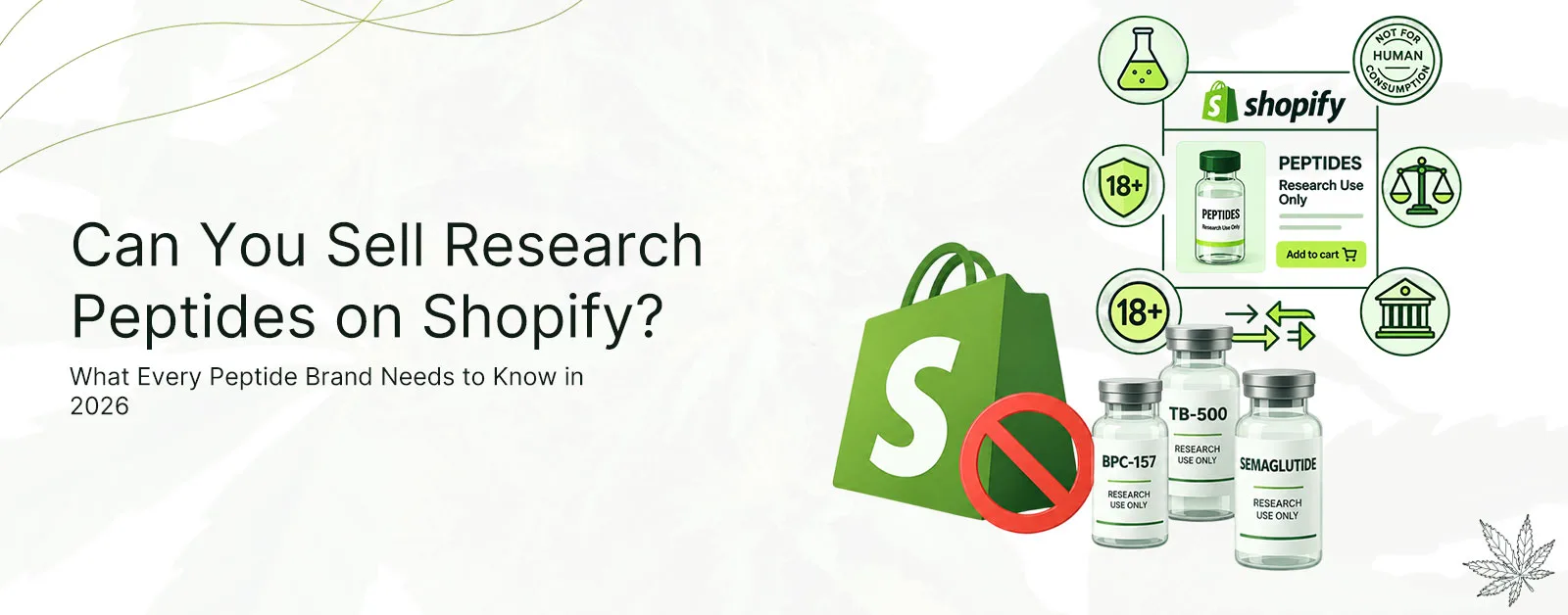
If you are building a research peptide brand, this is probably the first question you typed into Google before anything else. Here is the direct answer. No, you cannot sell research peptides on Shopify. Shopify’s payment eligibility rules block pseudo-pharmaceuticals and unverified health products outright, and research peptides such as BPC-157, TB-500, and RUO semaglutide fall squarely into that category, regardless of any “not for human consumption” label on the bottle.
In this guide, we are going to discuss exactly why Shopify holds this line, what actually happens when a peptide store gets flagged, and which platform gives research peptide brands a real, compliant path to grow in 2026.
What Counts as a “Research Peptide” Anyway?
“Research peptide” is the label most sellers use for peptides marketed as laboratory chemicals rather than drugs. These products sit in a strange middle ground. They are chemically identical, or very close, to compounds used in real clinical research and even FDA-approved medicine, but they ship with a disclaimer that says they are not intended for human use.
In practice, plenty of customers buying them are not researchers at all. They are fitness enthusiasts, biohackers, and people chasing weight loss or anti-aging results who found the product through social media rather than a lab supply catalog.
Common Types of Research Peptides on the Market
A few categories dominate the space:
- Healing and recovery peptides, like BPC-157 and TB-500
- Growth hormone secretagogues, like Ipamorelin, CJC-1295, and Sermorelin
- Metabolic peptides, like RUO semaglutide, tirzepatide, and retatrutide
- Cosmetic peptides, like GHK-Cu copper peptides used in skincare research
This mismatch between labeling and real-world use is exactly what makes platforms and regulators nervous, and it is the root of everything covered below.
Why Quality Varies So Much Between Vendors
That blurred line also explains why quality varies so much between vendors. A product labeled for laboratory use carries no obligation to meet the manufacturing, testing, or purity standards that an FDA-approved drug does, which is part of why regulators weigh marketing claims more heavily than the disclaimer printed on the vial.
Shopify’s Actual Policy on Peptides
What Shopify’s Payments Policy Actually Says
You do not have to dig through internet forum debates to find Shopify’s position. Shopify Payments eligibility rules list several high-level prohibited categories, and pseudo-pharmaceuticals sits right there in black and white as products that make health claims not verified by a local or national regulatory body, according to Shopify’s own Help Center. Shopify’s Acceptable Use Policy reinforces the same principle: merchants cannot use the platform for anything that requires regulatory approval they have not obtained.
Research peptides check that box almost automatically. Even a technically neutral phrase like “supports recovery” or “may support fat metabolism” reads as a health claim to a risk reviewer, and Shopify already prohibits prescription drugs and medical devices outright as a separate, related category.
Where Research Peptides Fall Under Shopify’s Rules
Here is how the mismatch breaks down:
| Shopify Payments Prohibited Category | Why Research Peptides Land Here |
|---|---|
| Pseudo-pharmaceuticals (unverified health claims) | RUO marketing routinely implies weight loss, faster recovery, or anti-aging results |
| Regulated or prescription-adjacent products | Many popular RUO peptides mirror prescription drugs like semaglutide and tirzepatide |
| High chargeback, high liability categories | Injectable compounds carry safety and liability exposure that acquiring banks will not underwrite |
Bigger Than Just Shopify
None of this is Shopify being uniquely strict. Its payment processing runs through a broader card network and banking supply chain, and those partners maintain their own restricted business lists that go even further than Shopify’s public policy. Shopify Payments settles transactions through processing partners with their own separate rules for pharmaceuticals and research chemicals, so even a future policy change from Shopify alone would not automatically unlock peptide sales on its own.
Why “Research Use Only” Labeling Doesn’t Change Anything
The FDA’s Intended-Use Standard
Sellers often assume the RUO label and a “not for human consumption” disclaimer create a legal shield. The FDA disagrees, and it has said so repeatedly through 2026.
The agency evaluates “intended use,” not just label language. If a product page talks about metabolic regulation, weight management, or muscle recovery, the FDA treats that peptide as an unapproved new drug no matter what the fine print says. In separate 2026 enforcement actions against sellers including Peak Performance Peptides and Wholesale Peptide, the agency made the same point each time: marketing context defeats the disclaimer.
Shopify’s Risk Team Sees It the Same Way
Shopify’s risk team reaches a similar conclusion from a different angle. It does not need to prove a legal violation to act. It only needs to see health-adjacent marketing language to classify a product as pseudo-pharmaceutical, and that alone is enough to trigger a policy violation.
What Actually Changes the Risk
The upshot is simple. No amount of disclaimer language rewrites a store’s risk profile. What actually determines it is the product, the surrounding marketing, and the platform’s own read of both.
This same intended-use standard is why cosmetic peptide brands that stick to structure and purity claims tend to draw less scrutiny than brands whose blog posts and social captions describe dosing protocols for muscle growth or fat loss. The product category is the same. The marketing decision is what changes the risk.
What Happens When You Try to Sell Peptides on Shopify Anyway
The Immediate Fallout
Some founders try it anyway, hoping the store flies under the radar long enough to build revenue. Here is what usually happens instead:
- Sudden account review or suspension, often triggered by automated content scanning rather than a manual check
- Frozen Shopify Payments balance while the “Trust and Safety” team investigates, sometimes for weeks
- Permanent account termination once peptides are confirmed, with no guaranteed appeal outcome
- Risk flags that follow the business, since acquiring banks report high-risk merchants to shared negative files used across card networks
Why It Follows You Elsewhere
That last point matters more than most founders realize. A termination is not just a Shopify problem. It can make the next payment processor application harder too, which is exactly why building on the right platform from day one beats trying to fix it after a shutdown.
The Research Peptide Market Isn’t Slowing Down
A Market Measured in Billions
None of this friction is stopping demand. The broader peptide therapeutics market, which includes FDA-approved drugs like GLP-1 medications, was valued near $140.9 billion in 2025 and keeps climbing at a high single-digit to double-digit rate depending on which analyst firm you ask, according to Grand View Research.
Demand Is Outrunning Caution
The RUO side of the market is smaller but growing fast enough to worry the people who track it professionally. LegitScript, which monitors high-risk products for payment companies and platforms, recorded 308 percent more ads for problematic peptides in 2024 than in 2023, and 678 percent more than in 2022.
A Volatile Supply Side
That growth comes with real volatility. Peptide Sciences, long considered the largest gray-market research peptide vendor in the US, voluntarily shut down on March 6, 2026, despite reportedly pulling in roughly $7.4 million in monthly sales just months earlier. At least ten other major vendors have closed since late 2024, based on industry tracking.
The Numbers at a Glance
| Metric | Figure | Source |
|---|---|---|
| Peptide therapeutics market size (2025) | ~$140.9 billion | Grand View Research |
| Growth in problematic-peptide ads, 2023 to 2024 | +308% | LegitScript |
| Growth in problematic-peptide ads, 2022 to 2024 | +678% | LegitScript |
| Peptide Sciences reported monthly sales, Dec 2025 | ~$7.4 million | PeptideLaws.com / Grips Intelligence |
The GLP-1 Effect
Much of this momentum traces back to the mainstream GLP-1 boom. Once shoppers grew comfortable with the idea of a weekly injection for weight management, a research-grade version marketed at a fraction of the pharmacy price became an easy next search, even though the two products sit under completely different regulatory frameworks.
The lesson for a new brand is not “avoid the category.” It is “build on infrastructure that can survive scrutiny,” because the regulatory and platform pressure is not going away, and neither is the demand.
So Where Can You Actually Sell Research Peptides?

Why WooCommerce Is the Practical Answer
If Shopify is out, the realistic answer for almost every serious research peptide brand is a self-hosted WooCommerce store.
WooCommerce is not a magic loophole around FDA rules or card network restrictions. What it gives a brand is control. There is no single company-wide Acceptable Use Policy scanning every store on the platform, and a self-hosted setup lets a brand connect the high-risk-friendly payment gateway or peptide payment gateway that actually fits its risk profile, instead of being stuck with one payment stack for the entire platform. Our team’s research peptide WooCommerce store development work is built specifically around this reality.
Shopify vs WooCommerce at a Glance
Here is the side-by-side comparison worth understanding before choosing a platform:
| Factor | Shopify | WooCommerce |
|---|---|---|
| Peptide products allowed | No, explicitly prohibited category | Yes, with the right payment setup |
| Payment processor choice | Locked to Shopify Payments and its approved list | Open, choose your own high-risk gateway |
| Compliance responsibility | Shared, but Shopify can shut you down unilaterally | Fully yours, with no platform-level policy risk |
| Hosting and control | Shopify-hosted, limited backend access | Self-hosted, full backend and data control |
| Setup complexity | Low | Higher, usually needs a developer familiar with high-risk builds |
Other Platforms Worth Knowing About
A handful of brands also use BigCommerce or Shift4Shop, but WooCommerce remains the dominant choice because of its flexibility with plugins, payment gateways, and compliance-specific customizations. If this feels familiar, it should. CBD brands went through the same platform migration a few years back, and the parallel playbook is worth a look in our guide to the best ecommerce platform for selling CBD.
What WooCommerce Does Not Fix
It is also worth being clear about what WooCommerce does not do. It does not make a peptide legal to sell, and it will not protect a business from an FDA warning letter if the marketing crosses into drug claims. What it removes is a single company’s platform-level veto over the entire product category, which puts compliance back in the brand’s own hands instead of a risk algorithm’s.
Building a Compliant Research Peptide Store: The Non-Negotiables
Getting off Shopify solves the platform problem. It does not automatically solve the compliance problem. A properly built research peptide store needs to nail a specific list of requirements before it ever takes its first order.
The Compliance Checklist
| Requirement | Why It Matters |
|---|---|
| RUO disclaimer and checkout acknowledgment | Confirms the buyer’s stated intent and creates a documented compliance trail |
| Certificate of Analysis (COA) hosting per batch | Builds trust and shows purity and identity testing that serious buyers expect |
| LegitScript certification, where applicable | Opens the door to more stable, long-term payment processing relationships |
| Multi-gateway payment architecture | Reduces the risk of a single processor freeze shutting down the entire business |
| Age verification at checkout | A baseline compliance expectation across every high-risk category |
| Neutral, structure-and-purity product copy | Avoids the therapeutic-claim language that triggers FDA and processor scrutiny |
Why This List Isn’t Optional
Most of these are not optional extras. They are the difference between a store that survives its first underwriting review and one that gets flagged in the first thirty days. Brands planning to sell in bulk to labs or offer local pickup for researchers should also plan POS integration early, since retrofitting it later is far more disruptive than building it in from the start.
Common Mistakes That Get Peptide Stores Shut Down
The Recurring Red Flags
A lot of the pain in this niche is self-inflicted. The same handful of mistakes show up again and again:
- Treating “research use only” as a legal shield instead of a marketing label
- Writing product descriptions with dosage, cycle, or stacking language aimed at personal use
- Running the entire business on one payment gateway with no backup plan
- Skipping LegitScript or any documented compliance program entirely
- Copy-pasting a generic Shopify terms-of-service template instead of writing peptide-specific policies
- Ignoring that a handful of states apply extra restrictions to certain peptide categories
- Launching with no documented refund, shipping, or privacy policy, which is one of the first things a payment underwriter checks
Avoiding these mistakes will not make a peptide store bulletproof. But it moves the business from “obviously non-compliant” to “defensible,” which is exactly what payment processors and regulators are actually looking for.
How High Stack Solutions Builds Peptide-Ready Stores
Experience Built on Regulated Markets
High Stack Solutions has spent years building compliant eCommerce infrastructure for Kratom, CBD, and Delta brands, industries that share almost the exact same pain points as research peptides: Shopify says no, mainstream processors say no, and one wrong build decision can end the business overnight.
Founders in this space often tell us the same story before they ever book a call: other agencies either ghosted them once they found out what the store would actually sell, or quoted a price that assumed the worst-case scenario. Building for a regulated category well means understanding the compliance requirements and the platform limitations before a single line of code gets written, not after the first payment processor rejection.
What a High Stack Peptide Build Includes
That experience carries over directly. Our research peptide website development process is built around WooCommerce from day one, with age gates, COA display, RUO checkout acknowledgments, and multi-gateway payment architecture built in rather than bolted on afterward. We pair that with automation for research peptide businesses, so repeat orders, compliance documentation, and customer communication run without manual busywork slowing the team down.
Resources for Related High-Risk Niches
For a broader look at how this applies across every high-risk category we work in, our guide to custom website development for high-risk niches is a useful next read. And if a Delta-8 or THCA brand you know is facing its own compliance deadline, our breakdown of the 2026 federal hemp ban covers what is coming and how brands are getting ahead of it.
Conclusion
So, can you sell research peptides on Shopify? No, and that is not likely to change. Shopify’s payment eligibility rules explicitly block pseudo-pharmaceuticals and unverified health products, research peptides trigger both categories, and neither a research-use-only label nor a clever disclaimer changes how the platform or the FDA reads the marketing around them.
Let’s Build Your Store
Ready to build a store that can actually take peptide orders without the constant fear of a shutdown email? Book a free strategy call and we will walk through what a compliant setup looks like for your specific product line.
FAQs
Can you sell peptides on Shopify at all?
No. Shopify Payments eligibility rules prohibit pseudo-pharmaceuticals and unverified health products, and research peptides fall under that category regardless of packaging or disclaimers.
What happens if Shopify shuts down my peptide store?
Shopify typically suspends the account, freezes the Shopify Payments balance during review, and can permanently terminate the store once peptide sales are confirmed, often with limited appeal options.
Can I use Stripe or PayPal directly instead of Shopify Payments?
Usually not. Stripe and PayPal both list peptides and research chemicals among their own restricted or prohibited business categories, independent of Shopify’s policy.
Is WooCommerce a legal way to sell research peptides?
WooCommerce is not bound by Shopify’s Acceptable Use Policy, but merchants still must follow FDA rules, card network restrictions, and state laws through their own payment gateway choice.
Is it illegal to sell research peptides in the United States?
It depends on the specific peptide, how it is marketed, and the state. Selling peptides with unapproved drug claims for human use can violate FDA law even with an RUO label.
What platforms besides WooCommerce can I use to sell research peptides?
BigCommerce and Shift4Shop are occasionally used, but WooCommerce remains the most common choice due to its flexibility with high-risk payment gateways and compliance plugins.