The Farm Bill 2018 left many loopholes for redefining the legal definition of hemp, as the bill exclusively defined the hemp-derived products illegal based on their Delta-9 THC concentration. Based on this narrow definition, manufacturers were legally allowed to manufacture and sell cannabis or hemp products containing intoxicating cannabinoids.
Since the other laws only restricted Delta THC-9, the other intoxicating cannabinoid products became broadly unregulated. These legal loopholes in the Farm Bill 2018 created substantial challenges for traditional employers. Workers purchased items labelled as legal hemp, consumed them, and then triggered the unwanted positive drug test on workplace.
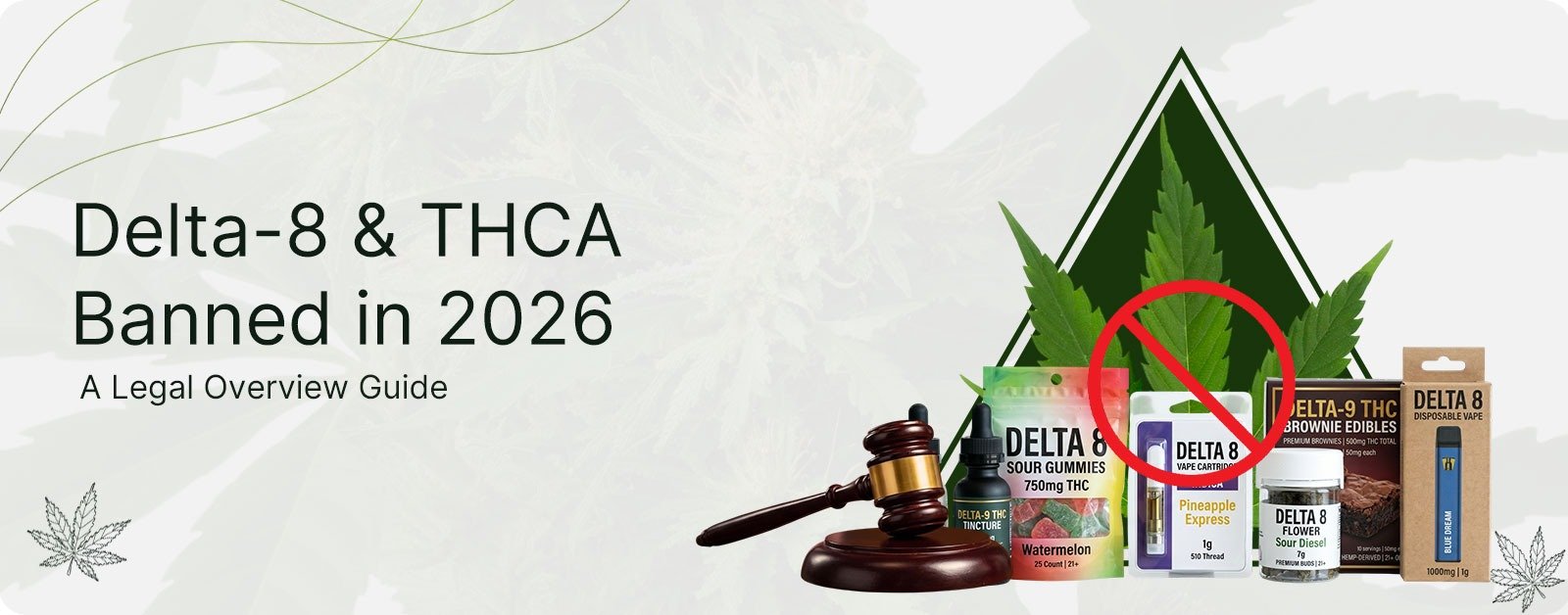
To address these legal loopholes in the 2018 Farm Bill and public health safety concerns, a new law has been imposed to ban Delta-8 and THCA which will come into effect after November 2026. In this article, we are going to address this new federal hemp law and how it is affecting other types of THC as well.
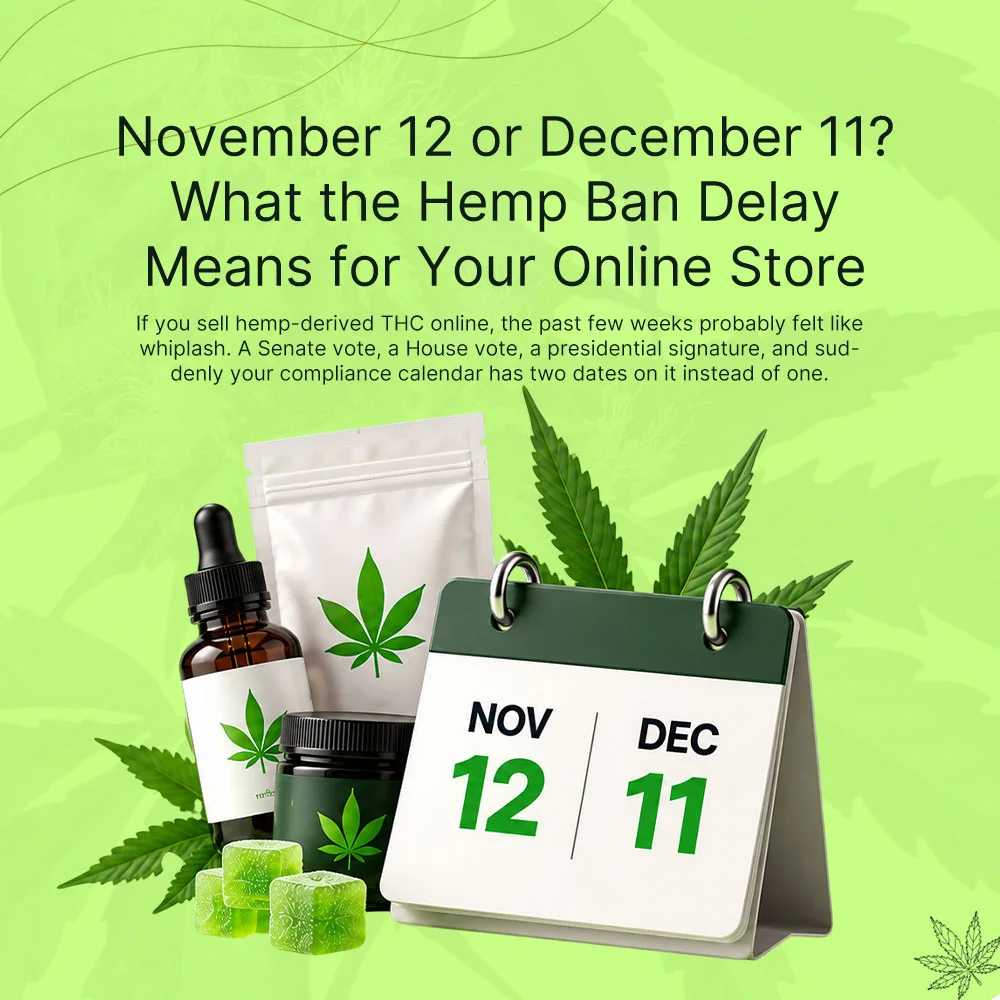
Read More: https://highstacksolutions.com/hemp-ban-delay-november-december/
How Does the New Federal Law Affect the Cannabis Industry?
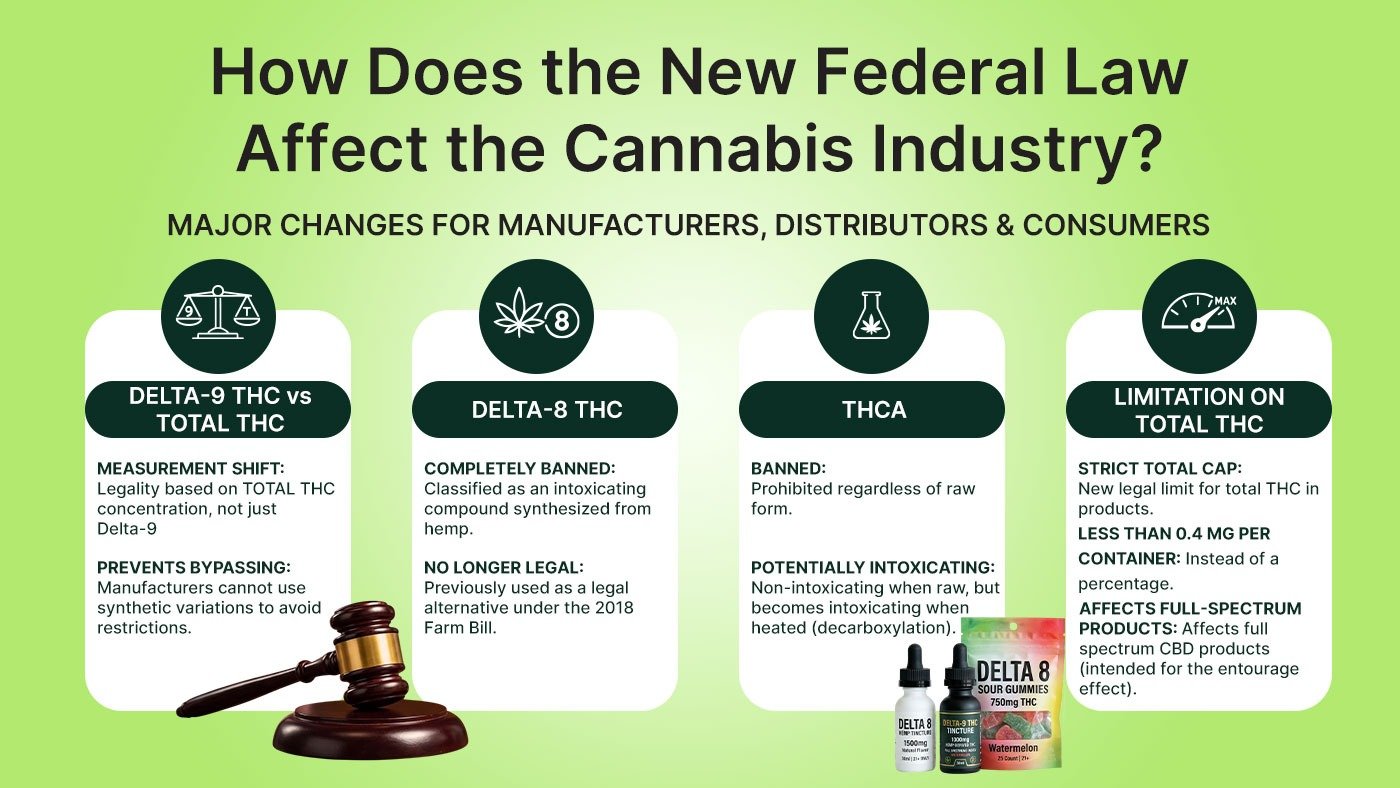
As for the federal hemp rules, the new law is changing how the THC-based products are being classified by the manufacturers, distributors and consumers. Let’s talk about how each type of cannabidiol is being classified under the new law, which is going to take effect starting from November 12, 2026:
Delta-9 THC vs Total THC
The new federal law redefines how the U.S. government classifies legal hemp. Instead of measuring the legality based on Delta-9 THC concentration (as in the Farm Bill 2018), the regulations will be imposed based on the total amount of THC. In simple words, the new legislation states that the THC manufacturers will no longer be able to bypass restrictions by synthesizing different THC variations.
Delta-8 THC
In addition to the Delta-9, the new November 2026 law completely bans the Delta-8 THC since it is classified as an intoxicating compound which is mostly synthesized by the manufacturers as a legal form of CBD. Based on the previous 2018 Farm Bill, Delta-8 THC was derived from legal hemp instead of marijuana, while companies significantly labelled it as the legal alternative to CBD.
THCA
Just like the Delta-8 THC, the November 2026 law also bans THCA. The thing is, THCA is labelled as non-intoxicating on the paper if it is in the raw form or unheated form. But if it is bypassed through the process of decarboxylation (which means if it is heated or smoked), then it becomes intoxicating for consumption.
Limitation on Total THC
A major quantity of THC products is classified as full-spectrum CBD products due to their successful chemical formulation on the commercial level. As a result, such formulation is purposely made to retain traces of THC in order to stimulate the endocannabinoid system to feel the entourage effect.
But the new law dictates a strict cap on the amount of THC found in the CBD products, according to which instead of a percentage, the acceptable legal product should have less than 0.4 milligrams of total THC per container.
How will the November 2026 changes take effect?
Now the main question is what the new enforcement of the November 2026 ban on THC will look like. The new law is defined as Public Law 119-37, which was officially approved on November 12, 2025. However, the restrictions are expected to take place beginning November 12, 2026.
What Does the New THC Ban Look Like for Employers?
The time window in this amendment was implemented to give employers a time window to take advantage of it as the transition period. So the employers have sufficient time to update their drug test policy. It also involves a pending legislation that may extend the implementation deadline from 365 days to up to three years.
What Do Law Enforcement Have to Prepare For?
Even though the timeline for the new THC ban is pretty clear, some bodies are still confused about how the law might be enforced. The law enforcement agencies (DEA and FDA) would likely need more time to define comprehensive protocols to make the federal hemp law effective. The implementation of this rule will require new guidelines from the FDA to state regulations from the marketplaces.
Federal Ban vs. the State Laws for Cannabis
The potential conflict after November 2026 may create confusion between the federal restrictions and the already existing state laws. Some states currently allow the sale and purchase of intoxicating hemp-based products while they actively regulate and tax these products. However, the other states where intoxicating CBD products face restrictions are taking action to impose a complete ban.
Individuals Belonging to Multiple States
There are individuals like multi-state employers which need to define a comprehensive decision tree to address the conflicts between the intra-state laws and the federal laws. As a result, the HR teams are expected to introduce strong policies to define the ban of Delta-8 THC products.
The new policies should be imposed while considering the November 2026 law update and local worker laws. For example, if an employee resides in a place where intoxicating hemp is allowed, the employer’s drug testing policy should take the stance as per federal law.
How Should Employers Prepare for the New Ban on THC?
The delay in the implementation of the THC ban gives employers sufficient time to prepare. As a result, employers can take proactive steps to update their programs by considering the following things:
Update the Substance Language
Employers should review their prohibited substance language to review current drug test policies and exclusively include the terms that prohibit THC.
Educate the Employees
It is possible that some employees may not have knowledge about the complications linked with the new law that bans THC. To deal with this, employers should distribute clear guidelines to the workforce highlighting specific types of cannabinoid products to avoid.
Supervisor Training
The managers and supervisors should be trained to note any possible signs of intoxication among employees. These signs may include reasonable suspicion raised on physical signs of impairment.
Implement Secondary Agreements
If applicable, the employers should evaluate procedures for re-testing, return-to-duty processes, and last-chance agreements to make sure these policies align with the new federal law.
Final Words
The new law totally redefines how CBD and Delta-8 THC are defined in legal terms. Beginning on November 12, 2026, the law will be imposed on a federal level to restrict any CBD product containing less than 0.4mg of THC. The employers, manufacturers, distributors, and consumers should take the right steps to stay in legal compliance in order to avoid any legal issues.
FAQs
Does the November 2026 Law Make Delta-8 Illegal?
Yes, under the new Federal Law on CBD, Delta-8 is going to be classified as a controlled substance, making it illegal on the federal level. As for the CBD ban defined in November 2025, the new term bans total THC which eliminates the loophole that allowed manufacturers to sell Delta-8 legally.
Is THCA Federally Illegal?
Starting November 12, 2026, many THCA products may become federally restricted if they fall under updated total THC rules, even if they were previously sold as legal hemp.
Will CBD Be Banned After the November 2026 Law?
No, CBD is not expected to be broadly banned, but products must meet stricter federal definitions and may face tighter FDA and labeling regulations.
How Should CBD Businesses Prepare for the New CBD Ban?
CBD businesses should review product formulas, strengthen compliance testing, update labeling, consult legal experts, and focus on clearly non-intoxicating hemp products.
What if my State Allows Delta-8 or THCA in 2026?
Even if your state permits Delta-8 or THCA, federal law can still override state rules, especially for interstate sales, shipping, and federal enforcement.